Showing posts with label reading. Show all posts

Tuesday, February 18, 2014

A Simple Post-It Note Organizer for Online Books

We have a plethora of technology in our district.  In fact, many of our classrooms have one-to-one devices.  While I definitely believe there is something to be said for turning the pages of an actual book made of paper, I am finding it more and more convenient to use online books, especially since we have a free trial of MyOn.com through the month of March.  (If you haven't checked out MyOn, you really should.  I'll write more about that in a future post.)
One problem that I have ran into with online books is, there's no place to put the sticky notes!  I love having my students stop and jot (or chunk and chat as it is sometimes known.)  They read a little, write a little, etc. Though there are ways to have them open a separate doc to take notes, etc.  I still like post-it notes and decided I needed to find a way to let the kiddos keep using them.
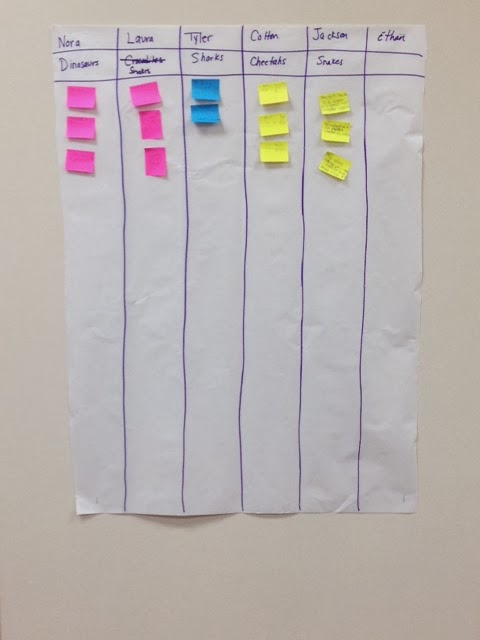
Hence, the post-it note organizer pictured below.
Quick and easy way to organize post-it notes for online reading.  Nothing fancy but very effective
It's pretty simple, really.  Every student has a column for his or her notes.  My students happen to be doing a research project so they have a topic under their names.  They are collecting information that they believe will be relevant to the report they will be presenting at the end of the project.  Each sticky has a fact written on it that they would like to incorporate into the presentation.  The presentations will be done through the technology app or website of their choice.  I named a few choices and they spouted off about a dozen more (and, I might add, they are first graders!) I made a point of telling them that these notes are for themselves so they don't have to be in complete sentences and I wouldn't be checking them for spelling. Though we have different times when we work on those skills, these notes are not for me and they don't need to be scrutinized.  If the notes I had taken when I was in school was graded, I would be in big trouble!
Another cool feature of organizing the notes this way is it allows students who have the same topic to collaborate. They can read a note and then ask the child who wrote it where they found that information.  It also drives interest in the topics ahead of time because students will read a note and wonder what other information about that note will be presented.
Overall, I think it's a great way to incorporate something we know works into a method we are sure to be using for many, many years to come.  It also creates an anchor chart, builds collaboration and conversation, and it brightens up my room a bit!
What are your thoughts?  How have you allowed students to take notes while reading an online text? Have you tried MyOn and what do you think?

Thursday, January 30, 2014

A Simple Way to Get Your Students WRITING

Our school district has been doing a book study on The Best-Kept Teaching Secret by Smokey and Elaine Daniels.  In case you haven't read it--the secret is that kids need to write more often.  I think we all know that already but I don't know if we truly understand how much writing impacts reading and other academic areas.  In the book, the authors give a plethora of ideas for how to get your students writing, regardless of whether you teach elementary or high school. There are tons of pictures and examples, which make the book an easy read and also quite entertaining.  Many of their suggestions revolve around letter writing and why this is a great way to get to know students better and build a community within your classroom.  I love using letters as part of my curriculum and did so when I was a classroom teacher. Since I've transitioned to my current position, letter writing has been one thing I've let go. I'm exited to start including more of it in my curriculum.
I've also been more cognizant of how often I am asking students to write responses after they read.  We know that reading and writing go hand-in-hand, yet I spend a disproportional amount of my time focusing on reading without incorporating many writing skills that will support students in reading.  I've been soliciting more writing recently and, while some students still complain because writing is hard for them, I have seen the writing impacting their reading and spelling skills.  As a Reading Specialist, my primary focus will still be on reading but I intend to include more written responses into my lessons.  Of course, I am talking about thought-provoking and creative writing activities--not writing answers on blanks on a worksheet.  We all know that this type of activity does not have the same impact when it comes to improving students' reading and writing skills.
One activity that I have incorporated recently is both simple and fun.  I am working with a group of first grade students on extension activities.  These are kiddos who are scoring way above grade-level in reading and many of them are also in our Gifted and Talented program. I love working with these types of students because they challenge my thinking as well.  This week, we worked on identifying the problem and solution in a story.  One of the stories we read was about a dragon with a sore back who needs a more comfortable bed. His human friend finds a solution when heat from a dragon's snort makes all of the corn in the field turn to popcorn.  The students loved reading this story but they loved writing about it even more, especially when they got to write on the white board with the dry erase markers.  With all of the technology we have today, we sometimes forget the overwhelming joy students have when they are allowed to do "teacher things."  This was certainly one of those things that they thought was cool.
Each student had the opportunity to write his or her thoughts on the board.

While the students loved writing on the board, this was also a very quick way for me to tell who really grasped what the problem was in the story and who needed to do some deeper thinking. Many of the students only wrote a short sentence, but you can see in the picture that one of them wrote a summary.  She definitely knew the problem and solution in the story and I let her help me reflect aloud on the story for the other students so that we could all consider  how the characters resolved the situation.  The entire activity took about 15 minutes (with 6 students) and by the end, everyone had a firm grasp on how to identify the problem and the solution in the story, as well as several other topics that came up during our discussion, which often happens with these creative thinkers. (We had a long chat about mythical creatures and why a dragon is a mythical character but Superman is not.)
A summary of the story, written by a first grader.  I love how she was able to synthesize  the whole story into a few sentences so succinctly.

How are you incorporating writing in your classroom and how are the students responding?

Wednesday, January 22, 2014

What Do You Infer?: Simple and Powerful Lessons for Figure 19D

This year I have had the privilege of working with several groups of 3rd grade students.  Though many of them are struggling with comprehension, the conversations we have are extremely interesting, particularly when we are practicing making inferences. And we practice making inferences a lot.  Because making inferences is hard when you are in 3rd grade--super hard.  And STAAR (our state assessment) expects 3rd graders to be able to infer like bosses.
Here are two lessons I use to help students understand the difference between what they know and what they infer.  The first lesson builds into the second lesson so I recommend using them both in the same order.
The objective of this first lesson is to teach the difference between gathering information that is obvious and making inferences. I begin the lesson with an introduction to the word inference and all of it's forms (correct or incorrect) such as infer and inferencing.   I give them an example of how they often infer information in every day life.  I demonstrate this by entering the classroom, shaking a wet umbrella.  Immediately, the students say, "It's raining!"  I ask them how they know and they site two obvious clues:  A) I have an umbrella and B) it's a wet umbrella.  I ask them if there are any other ways that I could have possibly gotten the umbrella wet. At first they usually can't think of any but eventually someone will come up with something, such as, "the sprinklers were on." Sometimes they throw in other forms of precipitation, such as, "It might be snowing." This is great because it allows us to talk about the difference between good evidence or clues and jumping to conclusions or using what we call "bad evidence" to make the wrong inference.  We talk about how the answers on the  STAAR test are often tricky and if they are not very careful, they might use evidence the wrong way or draw conclusions based on "long-shot" sorts of evidence. At the end, we determine that the best explanation for the wet umbrella is that it must be raining outside. We discuss how they were able to infer that without me saying a word.  We talk about how they use inferences all day long in real-life.
This leads directly into the next part of this first lesson.  The only resource you really need is an interesting photo, which you can easily obtain from the internet.  I give the instructions first.  "We're going to look at a picture.  I want you to look carefully at the picture and then, in a moment, I'm going to ask you to tell me what you see.  You can only tell me what you actually see, not what you think is going on."  I give the students a few minutes to study the picture and then we discuss what they see. When they accidentally make an inference--and at first this happens very frequently--I stop them and we talk about why their statements were an inference, what evidence they used to draw that conclusion and why it might be incorrect.  Usually, their inferences are pretty spot on and I have to really stretch to give them an example of why they might be wrong.  This is good for them, however, because it gives them an idea of what misleading evidence looks and sounds like.
Start with an interesting picture.  What can you see?  "A girl.  Trees."  What do you infer?  "She's pretending to be a fairy." Photo courtesy of Glitter and Tulle Boutique

After the students have listed all of the things they see, I let them explain what they think is happening.  This allows them to practice making inferences.  We talk about the supporting evidence that they found.  We talk about other possibilities and sometimes there is a bit of debate but most of the time the students draw similar conclusions from the pictures.  The kids love this activity and always (and I mean always!) beg to do it again--and then to do another one and another one.
Once my students have practiced this activity a few times, I lead them into the next activity.  This one follows the same steps, except for, instead of sharing their thinking out-loud, I have them make a graphic organizer and record their thoughts in writing first and then share.  This gives them the opportunity to write, which also allows them to think without being interrupted by someone else shouting out his or her ideas.  You can see a picture of the graphic organizer below, but it's pretty simple.  I have the students label the top of their paper "Inference" and then make two boxes, one for what they see and one for what they infer.  Even though a lot of my students hate to write, they enjoy this activity almost as much as they do the first activity where they are just looking at the pictures.  We've done both of these activities several times now and most of the kids are getting to be real pros at it.
On the left, you can see how my student recorded what was happening in the picture.  On the right is her inference.

Our next step will be to apply our inferences to texts.  I will start with good, authentic literature and then transition into grade-level passages that the students can read on their own.  I won't introduce written questions and answers until they are very good at both listening to texts and making inferences and then reading texts and making inferences.  For higher students, you may not need to scaffold so much but for my friends, this will give them a better opportunity to solidify the skills they are being introduced to, one step at a time. Otherwise, they will never cement the process, they won't have the opportunity to learn how to think or how to pay attention to their own thoughts, and they won't understand the academic vocabulary, which is a huge factor in determining who sinks and who swims when it comes to state assessments (and life in general!)
What lessons do you have for inferencing?  Please feel free to post them in the comments!

Monday, January 6, 2014

What's Your Superpower for the New Year?

School is back in session here at CISD and our kiddos are so excited to be back at school!  Okay, maybe not all of them--but most of them!  As much as we enjoy being home with our family and loved ones, it is especially nice to hear the excited little voices exclaim our names when we walk through the doors in the morning, as if we are some sort of celebrities.

To many of our kids, we do have celebrity status.  We are their heroes--Superheroes--the people who are always there for them.  We have a great opportunity to change the lives of these children forever, to give them the tools, knowledge, and skills they need to be successful in this ever-changing world.  That is a tremendous amount of responsibility but it is also an amazing honor. So, now is the time to change some lives!

What Superpower will you be using in these next few weeks and months to challenge the thinking of your students? 

What's your superpower?
Photo courtesy of Glitter and Tulle Boutique

As we set our plans for the second semester in motion, we will need all kinds of Superpowers to make sure our kiddos are successful.  We'll need powers of planning, powers of data review, powers of implementation, and critical-thinking powers! Our kiddos will need these powers, too! We all know that state assessments are looming for most of our kids and it is very easy to let the weight of those assessments bring us down.  But we cannot think of state assessments as kryptonite! The approaches that we take in our teaching, the ones that incorporate higher level thinking skills into the curriculum can fundamentally change the way our students approach problem-solving,  will not only prepare them for assessments, it will prepare them for life. We need to make sure that we are incorporating as many of these higher-level thinking skills into our lessons plans as possible so that our kiddos grow their super-strengths and are able to defeat all of lives challenges, not just the Evil State Assessments.

As you reflect on the first half of the school year, how do you feel about where your students are? Your answers to these questions may increase your superpowers.   How do you feel about your approach to teaching--have you pushed hard enough and asked tough questions?  Have you made learning fun and engaging?  How have you differentiated for those learners who need scaffolding or more challenging work?  Now is the perfect time to reflect on where our students were, where they are now, and where they need to be.  The next question is, how do we get them where they need to be?

Knowing the exact level of super-strengths (a.k.a. knowledge and skills) each of your students currently has in reading is critical.  If you're not exactly sure what each student is capable of when it comes to reading, there are some great tools that you can use to gather this information. If you have access to a Developmental Reading Assessment (DRA) or something similar, this  would give you great information about specific reading skills for each student.  Reading A-Z has a similar product with their Benchmark Assessments. You can check those out by visiting the Reading A-Z website here.   IStation can also give us some great information as to what our readers can and cannot do.  If you're not familiar with this amazing program, you can check it out here.  Every student in your classroom needs a clear-cut plan to grow his or her Superpower of Reading to maximum capacity by the end of the year.
Are your little superheroes ready to  fly?
Photo courtesy of Glitter and Tulle Boutique


In CISD, one way that we have done this with our third grade readers is to give a reading benchmark assessment to determine where our students are currently reading and then classroom teachers and I (the Reading Specialist)  created an end goal for each student. For most, this will be the end-of-year reading level expectation for third grade.  However, for our students who have special needs or other challenges, this may vary.  We looked at how many weeks we had until the student needed to meet that end-of-year goal and set check-points along the way.  We will be able to carefully monitor the progress of each student this way, in order to determine whether or not he or she is making adequate gains.  If not, we will need to adjust our teaching strategies to meet the individual needs of each student.  If a student isn't meeting check-point expectations, we will need to begin discussing what we can do differently, exactly where the student is struggling, and pinpoint our instruction to those exact skills.  Without the data from the benchmark and the subsequent check-points, we won't have a clear picture as to whether or not the student is making adequate progress until it's too late.  Knowing each of our students and their strengths and weaknesses is critical.

If you haven't done so, I strongly suggest you go back and look at your data and create a plan for each of your students.  If you need help doing this, ask a reading specialist, academic coach, team leader, or administrator to help you.  If you feel you don't have adequate data on all of your students, discuss what resources are available to you so that you can find out exactly what reading skills each of your students currently has and what they need to learn next, in order to successfully meet grade-level expectations.  Great discussions leads to great teaching, which leads to great learning so don't be afraid to approach a colleague to talk about your student data.

It's a new year full of new opportunities. Soon, these students will be on someone else's class roster.  When they leave your classroom, will they be prepared?  Let's use all of our superpowers to make sure all of our kiddos move on knowing everything they need to in order to be successful next year and for all of the new years to come.

Thursday, July 25, 2013

Reflection and Preparation for the New School Year

It's still summertime for a few more weeks, but like most of you, I'm starting to think about the new school year.  Before we know it, we'll be back in the swing of things. Ah, the smell of crayons and glues wafting through the air, sticky fingers grasping our pants accompanied by requests for another ketchup packet, the sound of the pencil sharpener whirring as we try to explain an important concept. These are the sights and sounds of an elementary school and I can't wait to see all of those little faces, freckled from the beach or too many hours outside, smiling up at me as they march down the hallway. While I've certainly enjoyed the time spent with my two little smiling faces at home, I've missed my other children oh so much and I can't wait to hear how their summers have been.
These smiley, precious faces are on their way back to school soon.  Are you ready?

As we contemplate those first few days back, we need to reflect on the lessons we learned last school year. We need to consider all of the professional developments we've attended this summer, all of the books we've read, and figure out what we can do to incorporate those important pieces into the puzzle that makes up our school year.  Going back to school is exciting because everything is new, we have the opportunity to make corrections and re-write who we are as instructors.  If we've always done things a certain way and it has left us feeling incomplete, we don't have to do it that way anymore.  There is no routine or procedure set in place--yet--we still have the opportunity to establish what that is going to look like for this set of children. While they are spending these last few fleeting days playing and enjoying the sunshine, we are constructing a framework that will determine so many crucial portions of their futures. It can't be taken lightly.  Our planning, our preparation, or lack there-of, sets the course for the rest of the school year and if we don't take it very seriously, our students' year could be misdirected because of the choices we make now.
That's heavy stuff!  Luckily, we are all professionals who take our jobs very seriously and we are willing to do whatever it takes to insure our students are successful.  So, let's take some time to reflect and really consider what we need to do differently, what can stay the same, and what we need to find out before we ever have one teeny-tiny foot cross the threshold into our classroom. The following is a set of questions designed to get you thinking about last year, reflecting on your teaching skills, and considering what you might need to change.
1) In thinking about the physical layout of my classroom, what really worked for me?  Were students desks placed in a good proximity from each other and the things they needed?  Was everyone able to utilize all of the materials available to them?  Was there ample access to the word wall and classroom library?
2) What about my classroom layout was confusing, messy, or chaotic?  Were there any pieces of furniture constantly in the way? Did students have trouble accessing anything they really needed?  Were students constantly asking for my help with certain items? How could I rearrange furniture or materials so that this isn't a problem anymore?
3) During what types of lessons were my students most often authentically engaged? Did they seem to prefer hands-on activities?  Did they really like technology?  How did they react to my style of direct-teach? When I begin planning for the upcoming school year, how can I incorporate more of these types of activities into my lesson plans? Did I plan ahead by writing higher-level-thinking questions into my lesson plans?  Did children leave my classroom with better knowledge of how to think and problem solve?
4) When did my students tend to check-out or act-up?  Was it during a particular type or types of lessons?  Did I "stand and deliver" too often?  Did my students tend to yell out because they were bored? Did I challenge my higher students often enough with independent studies, differentiated lessons, or projects? Did I make lessons too difficult for my lower students because I didn't differentiate? How can I be better prepared this year so that I can avoid teaching to a classroom of disengaged students? What strategies can I use to re-engage students once I've lost them or prevent those students on the brink from slipping away? What activities could I put in place to create a better sense of community within my classroom?
5) How did I meet the needs of all students through my small group instruction?  Did I do enough differentiation? Did I challenge my high students?  What resources did I do a good job of utilizing last year for small group instruction?  What other resources are available?  How can I insure that students are using their time in small group most effectively?
6) Did I do a good job of using my data to drive my instruction?  How often did I disaggregate data or study data that was disaggregated for me?  Did I have a firm grasp of what I was looking at and if not did I ask appropriate questions?  Do I understand why it is important to use my data to guide my instructional practices?  If not, who can I discuss this with?
7) What types of discussions did my team most often have during planning sessions?  How much time did we spend off-task, if any?  How many of our discussions were truly meaningful?  Did we talk more about the "what" or the "how" of teaching?  What can I do to contribute more to team planning?  What types of conversations would it be most beneficial to have?  What items could we bring to planning to help facilitate better discussion?
8) Did I utilize all of the resources that I had available to me during the last school year? Did I do a good job of asking my teammates for assistance when I needed it? Did I rely on my team leader to help me when I wasn't sure what to do? What kinds of conversations did I have with other staff members who also teach my students, such as special education teachers, dyslexia teachers, reading coaches?  Did I meet frequently with specialists, such as Academic Coaches or Master Teachers, to talk about my lessons and how I can improve my instructional practice? Did I discuss areas where I can grow with my administrator and ask for advice about workshops to attend or literature to read?
9) How was my communication with parents?  Was my newsletter effective or was it just something I checked-off on a list of "things-to-do"?  Did I call parents for good behavior as well as to discuss problems?  Were we able to work together to problem solve or were we often defensive?  What could I do differently to create stronger bonds with parents and work more effectively?
10) What steps did I take to create lasting relationships with my students? Did I greet them all warmly each morning? Did I take an interest in their lives outside of school?  Did I have meaningful conversations with them about non-academic subject matter? Did I instill morals and values in each of them? Did I teach them to love learning and to always strive to learn more? Would they say they had a great year and that they learned a lot or were they happy to be rid of me at the end of the year?  How can I work towards building better relationships with my students this year?
As you read over this extensive list of questions, there may have been one or two that really stood out to you.  Of course, you could take the time to sit and reflect on all of them, but that would be very time consuming.  If you noticed a question or a set of questions that really stuck out in your mind, chances are, there is some room for growth on this particular topic.  I suggest you actually take out a pencil and paper and write down your answers to these questions.  Taking the time to write out your answers will help you reflect in a more meaningful way then simply thinking about it.  Through reflection, we make discoveries about ourselves that lead us towards being even better at what we do.  If you don't have the answers, reflection can help you realize this as well, and it can guide you to the person or people who can help you find the right answers.  I think many teachers are under the impression that they have to be perfect and that's unfortunate because it's only through embracing our areas of difficulty that we can truly grow and become stronger, better teachers.  Take the time to reflect, to think, to plan, to build a strong foundation and framework. Those cute little smiling faces will thank you for it later.  They might have sticky hands, but they also have warm hugs, and warm hugs trump sticky hands any day.


Thursday, June 27, 2013

What Does Last Year's Data Mean for This Year's Kids?

Yesterday, I spent about 3 hours working on disaggregating end of year data to give to our staff.  I'm placing students reading scores on a scatter graph and also charting the difference between the middle-of-year scores and end-of-year scores so that teachers can see movement.  I'm also giving them over-all data, like how many average points each student has changed, what their over-all class average was on this assessment, etc.  As I am working on it, I am thinking, "This is really important and could be critical to our students' learning for next year. I wonder if everyone will understand why."
Some teachers might think, "Oh, well, that's last year's stuff. Those kids are gone.  I don't need to look at that."  But you do--for lots of reasons--but here are the two main reasons.
1) This data tells you where your strengths and weaknesses are as a teacher.
2) The data on the students you will be getting tells you where you need to start with your new class.
Let's look at these reasons a little bit more closely.
As teachers--as humans--we all have areas where we need to grow.  If you see that the majority of your class seems to be struggling in one or two areas, that's probably more attributable to you as a teacher rather than all of them as individual students. We can even look at this in  broad areas, such as fluency, accuracy, and comprehension. If you have a classroom full of speedy readers, congrats, you are awesome at teaching fluency!  I would like to tap into your knowledge of teaching fluency and work with you to help others improve in that area!  However, if you notice most of your kiddos are struggling in the area of comprehension then we need to work on that.  Luckily, you are not alone, for I am here to help you with that! So is the rest of your team and your administrators.  Isn't that awesome?  Chances are you have some strengths that you can share with the rest of us as well.  This is where that amazing buzz-word "collaboration" comes in.  You see, we don't need an administrator to come in, look at your scores and say to you, "You have got to improve in your ability to teach comprehension. Here are a list of workshops you need to go to. I will come in and watch you 45 times in the next three weeks to make sure you are doing exactly what you are supposed to be doing," etc. (That is not how my administrators roll, by the way, but y'all know what I'm talking about!) If you know your data before anyone else does, then working toward correcting the areas where you are struggling is in your hands and no one else's.  It leaves you open to be the conversation starter.  You can approach your team and say, "How are y'all teaching comprehension?  What specific types of questions are you asking? Does anyone have a great lesson for main idea?" etc.  We could get a lot more specific and look at student expectations one by one and see exactly where we need to work harder, but for the sake of this post, I think you get the idea. If you are really looking at your own data, more so than anyone else, then you will always be prepared to answer any questions that may be thrown your way.  Better yet, you will constantly be improving in those areas if you recognize that you need to.  The bottom line is, when one or two kids don't get it, that may be their fault. When the whole class doesn't get it, point the finger back at yourself because there are some changes that need to be made (assuming there's nothing wrong with the test or the way the questions were asked, etc.)  You aren't alone though and I, for one, am always happy to help teachers find resources, people to observe, books to read, etc. that will help them grow in areas where it is needed.
Let's talk about the second reason  why you need to look at last year's data.  This data has some really specific information about your new students.  Do I really expect you to take the time to look through the scores of every single one of your new kiddos?  Absolutely! Do I realize how much time that might take?  Absolutely! I always--always--looked at whatever data was available to me and made it my mission to know as much about each student as possible before school even started.  The second I knew my class list, I was in the cumulative folder closet looking at those files. If we had portfolios, even better.  Why?  This is my starting point. I'm going to forego the argument that kids lose ground over summer.  Of course they do (so do I!) but I am looking at the potential starting point--where I know they should be--soon--so that I know where we need to work and where I can help them excel.  This is critical.  If you can't get your hands on last year's data, start asking everyone you can. Last year's teacher, an instructional specialist, admin, the school secretary, whomever may have that information because it is critical to you.  You don't want to find out two months into school that the shy boy in the back is actually reading three grade levels ahead because you've just wasted two months of his time.  Likewise, you don't want to find out that you have a potential special education student that no one told you about or that Johnny is supposed to be getting ESL services but no one told your or that Sally is at-risk because she repeated kindergarten.  Is someone supposed to tell you those things?  Sure!  Does it always happen? No!  Whose ultimately responsible for these kids?  You! So get in there and make it happen.
Here's a little story to go along with my point.  My third year as a teacher, I switched school districts to Cypress-Fairbanks ISD outside of Houston and I was teaching first grade at Owens Elementary school.  Lovely campus, wonderful staff.  I didn't know a single child on the campus and I knew it was critical that I knew my kids.  Cy-Fair schools put pictures of the students inside their cumulative folders.  As soon as the principal handed out the class lists, I went into the records room, memorized names and faces and any other information I could find out about these kiddos. On Meet the Teacher night, the parents were amazed.  I knew all of the kids as they walked in the room.  I greeted them by name, shook their hands, made them feel welcome right from the beginning.  They were all apprehensive because I was new there and they didn't know me at all from the year before. This set both the students and their parents at ease. The parents were amazed.  One mom said, "How did you know who my daughter was?"  I told her I had looked at their folders because I was so excited to meet them.  From that point on this mother, and many others, new their children were safe, they were going to learn a lot, and they were with a teacher who cared about them immensely  because I took the time to know them. Wouldn't that be an amazing way to start your year off as well?
Know your students and you will know exactly what they need to learn just in time.  Find out this information from last year's data. It's critical to making sure you are at your best as a teacher and that your students are at their best as well. Besides, who needs to sit on the beach and sip a nice cold drink when you can be pouring through data like me, right? Hello?  Anyone? Anyone?

Friday, March 22, 2013

What's the Word?

Just a quick post today, since we are all dreaming about the weekend!
I wanted to discuss word walls and some easy ways you can use them in your classroom to help support reading acquisition skills, writing, and vocabulary in every subject. Most of you probably have at least one word wall in your room.  How are you using them?  Are they a part of your direct teach lessons? Are students using them?  Are they just there?  Hopefully, this post will give you a few ideas for how word walls can be used.
The primary reason we have word walls is so that students can use them as a resource. If your word wall is in an area that is inaccessible to students,  you might consider moving it.  Kids should not only be able to see it, they need to be able to reach it.  They should be able to remove words, use them, and put them back.  I know this makes some elementary teachers cringe because they picture a disheveled word wall where everything is out of order and crooked!  But, that's what I love to see when I come into a classroom.  It shows me that the kids are using the word wall.  Magnetic words or Velcro are perfect because a student can take the word to his or her desk, use it for writing or whatever they need, and then put it back.  When a child actually has the opportunity to touch the word, carry it around a bit, use it, and then return it, they are more likely to own that word.  It really has a great impact on their ability to remember the words.
I also recommend you use it during your guided reading groups. I tell students that, if a word is on the word wall, they are responsible for it. If a student consistently gets stuck on a word in a guided reading book, and that word is on the word wall, I ask the student to go find it.  Again, more ownership.  I say things like, "This is your word.  You have to stick it in your brain so you can find it." We talk about the letters, the sounds, where we see that word and then the child puts it back on the word wall. Periodically, I will ask him or her about their word throughout the day so that they have constant reminders of what that word is, what it looks like, and why it is important.
Word walls should be accessible, kid-friendly, and organized 

There are all sorts of games you can play with the word wall during your literacy block, mini-lesson, small group, direct teach--basically anytime.  You can have students guess what word you are thinking of by giving them clues. You can do word sorts.  Have them sing the word wall.  We would sing, "I can spell "the."  I can spell "the." T-H-E, yes, I can spell "the." This same melody fits with just about any song. For centers, you can have them write the room, including the word wall.  Have them use the words on the word wall to make sentences.  They can take turn with a partner.  Word sorts work great here, too.  Have them take off a few rows and put them back on.  Anything that is engaging will go a long way towards helping them learn those words.
For vocabulary, I suggest a word wall for every subject.  Each time you have a new vocabulary word in science, it goes on the science word wall.  It doesn't have to be alphabetical.  In fact, it often helps if it is by unit. Rely on this word wall during your lessons. Point to it when you're using the word. Have the students create illustrations to go along with the word and hang those up, too.  It's okay to retire words from any word wall once your students don't need them any more but continue to make them accessible by hanging them on a ring or putting them in a basket so students can refer back to them.
Finally, I suggest you create a word wall for each student.  Just use a manila folder.  Each letter has a box and students can fill it in as they go.  Not every student will need every word but if you see that a student is consistently struggling with a word, add it to his or her word wall.  This is extremely helpful during writing when children constantly want to ask you how to spell a word and you are busy conferring with other children.  Write it on a sticky and have them transfer it to their word wall. Easy and effective.
I know there are many more great ways to use a word wall.  What are some of your favorite activities for word walls?

Wednesday, February 27, 2013

"We're Going to Eat Bananas!"

Early in my career, I had the honor and privilege of working with a principal who forever changed my philosophy about education.  He is one of the most intelligent, kindest, inspiring individuals I've ever had the opportunity to meet and working with him for two years was the catalyst for me to pursue leadership positions and aspire to be more than a classroom teacher. He saw potential in me--he saw potential in everyone--and he encouraged me to follow the path to administration.  I believe I've found my true calling because of his encouragement.  He encapsulates the true meaning of the phrase "servant-leader" and I hope someday to have a tenth of the wisdom that he has.
Though this principal was certainly born with an aptitude for leadership and inspiring others, he also continuously read the literature. He was always digging into what the educational leaders were saying, analyzing texts, and trying new methods of best practice.  He would share what he was reading with all of us, sometimes by recommending books and articles but often just through the words he chose.  Many of the mantras I now have as an educator have come not from their true sources but from listening to him repeat them time and again. He was constantly reminding us that, "we own all kids."  This is something I certainly take to heart.  He would remind us that, "leadership is not a position."  We are all leaders. If we see a task that needs to be done, it is our responsibility to move forward and solve that problem.  He was always talking about rigor and building capacity.  I have a much deeper understanding of what being a servant-leader means because of the words he consistently repeated to us at staff meetings, in conferences, even while passing us in the hallway.
Many times his words were paraphrased from something he had been reading.  This next example is no different and though I've read the true source, I like his version much better because it made it real for all of us.  At the time, I was a kindergarten teacher and he was talking about preparing 3rd, 4th, and 5th graders for TAKS (our previous state assessment).  While he may not have been speaking directly to me, I understood what he was saying and I took it to heart and applied it to my class as well.  He would say,  "If our students are going to be asked to eat bananas, then we're gonna practice eating bananas. We're not going to color bananas, we're not going to draw bananas, we're not going to complete a worksheet about bananas. We're going to eat bananas!"
Banana anyone? Pic courtesy of etipsfree.com

On the surface, it may be difficult to understand exactly what he was saying but with some thought and reflection (and some explanation!) it made a lot of sense.  What is it that we expect our students to be able to do?  Think at a higher level and be able to answer higher-level thinking questions on STAAR (our current state assessments) and in life.  How are we going to prepare them to do this? By teaching them how to read and analyze texts, story problems, scientific reasoning problems, etc. at the same level they will need to be able to in order to be successful on STAAR and beyond.  He wasn't saying let's passage them to death--quite the opposite, he was saying we have to replicate the demand of the assessment through authentic work (as in Schlechty's Working on the Work, which is not the same as busy work) that prepares our students for assessments and for the real world.  Furthermore, the vast majority of worksheets, fluff, and other lower-level activities are not going to prepare our students for the rigors of assessments or life. Just as coloring a banana is not the same as eating a banana, doing a worksheet that helps us find words that have prefixes and suffixes is not akin to understanding the meaning of those words in the context of a book or a difficult reading passage.  Being able to dissect a word on a worksheet does not necessarily lend itself to a student being able to use context clues to figure out the meaning of a word in text.  We must consistently give our students the opportunity to practice eating bananas if we want them to be able to eat bananas on the "Big Day".
How do you determine if an assignment is actually helping prepare your students or if it's just filling time? You can start by asking yourself the following questions:
1) What do I expect my students to accomplish by completing this assignment?
2) Will this assignment prove to me that my students understand the SE (student expectation) at a higher-level?
3) Will my students ever be in a situation in life or on an assessment where they will have to replicate the exact skills or knowledge they are practicing with this assignment?
Answering these questions should give you a clear indication as to whether or not the assignment is a good one or if it's not going to help your students eat bananas.  If you are having trouble finding an assignment that does fit the criteria of all three of these questions, you may be making things more complicated than you need to. Many of the SE's in reading can be taught through great literature, which makes it much more simple for teachers and students alike.  There is no law that says your students have to complete worksheets. In fact, in the last four years that I was in the classroom, I may have used a total of ten worksheets--and that's probably stretching it.  I know that math teachers often have a different purpose for using worksheets and I understand that purpose though I also encourage math teachers to make learning as authentic as possible as well.  Story problems go a long way toward stretching the students' thinking and they are a lot more fun when they're not on a worksheet. Math and science journals are great alternatives to worksheets. For reading, one of the simplest and best ways to get students to truly think is by asking them to record their thoughts in a reading journal.
Think of the great teachers and administrators you have had the opportunity to work with.  What was it about them that made them great?  How can you replicate those qualities in yourself and in your students?  How can that transform your classroom? I'd love to hear your ideas for making work authentic for your students.  Please leave a comment if you have a great idea you would like to share with other educators.

Monday, February 25, 2013

The Art and Science of Teaching Reading

Anyone who has ever taught reading before knows that you have to be both a master artist and a skilled scientist in order for your students to pick up all of the skills they need.  Some kids learn basic skills quickly but lack the finesse of great readers so we have to help them develop those skills--expression, inference, foreshadowing, discussion.  Other students have difficulty gaining an understanding of the basics--decoding, sight words, punctuation.  We have to take more of a scientific approach with these students.
Every year I have a number of teachers ask me what they can do to help their students become more fluent readers.  This is both tricky and simple at the same time.  We want a program or a step-by-step procedure to follow. And there are some things you can do, like having your students play, "Chase the Pen" where you move the pen ahead of them at the next words so they have to try to catch up to it.  You can do it with a race car or just about anything. Kids like it and it does improve fluency.  But the best way to increase fluency is by giving your students the time to read aloud everyday. The key word being "aloud."  When we have Drop Everything and Read (DEAR) time, most students are reading silently.  That's great but it's not going to help fluency as much as reading aloud. If a student reads a familiar text aloud several times, and has also heard another good reader read the same text several times, this will help improve fluency for students who are good decoders and are just slow  methodical. However, if your student doesn't have good decoding or accuracy skills then fluency is going to have to take a back-burner to building up the child's ability to word call.
Students Reading to Self, courtesy of educators.com

This is often where the science part of reading comes in to play.  I was once at a meeting with about 100 other reading teachers.  The presenter asked us if we knew in what order reading skills are generally acquired.  There were a lot of blank faces.  We weren't sure exactly what she meant.  I raised my hand and said that letter names comes first--which was correct much to my relieve.  We were then able to tell her letter sounds and then there was a lot more silence before people just started randomly guessing.  It turns out there weren't very many of us in the room who knew the logical progression of how reading should be taught and acquired by our students, so let me give that information to you so that if you didn't know before, now you will.  It's important because your curriculum needs to match up and you need to know what your students are ready to learn next in guided groups or one-on-one.  After all, if we wait on the curriculum for all of our students, we are going to put some students way behind where they should be and others will never have the chance to catch up.
Here is the progression:
letter names
letter sounds
vowel-consonant words
consonant-vowel-consonant words
CVCC
CCVC
CVCe
R-controlled vowels
Consonant digraphs (th, ng, sh, wh, ch, igh, ck, kn, wr, nk)
Vowel digraphs and diphthongs (oa, ea, oo, ee, ai, ol, ay, ou, oi, oy, au, aw, oe, ew, ow)
Prefixes and suffixes
Two syllable and multi-syllable words
Basically, that is the order that we introduce words, with the exception of two syllable and multi-syllable words that fall into previous categories.  Here's the catch though--if we have kids that are way ahead in the progression and we are insisting that they cover something two steps behind with us while we go over it for the rest of the class, we're wasting their time.  Likewise, if the class is covering vowel dipthongs and Billy can't decode CVCe, he's not going to be ready for that lesson and isn't going to get anything out of it. So, we're wasting his time as well.  I strongly recommend the majority of the time you spend covering word work and decoding be in your small groups, with the exception of kindergarten classes where the majority of your students are on the same level. That doesn't mean don't throw a mini-lesson out there once a week as a reminder to everyone that "ou" usually says /ou/ like "out" but if the majority of your time is spent teaching these kinds of skills in whole group, you're likely spending a lot of time covering material only a small part of your class needs "just in time."
Another point I would like to make regarding the coverage of these skills is that we need to speed it up.  We can no longer wait until the middle of first grade to teach students r-controlled vowels, digraphs, and diphthongs   Why?  State mandated testing won't let us. We are expecting our students to know how to read well, extract and analyze information, and draw conclusions in third grade.  If they are just getting to be solid readers at the end of first/beginning of second they will drown in third.  We've got to teach these skills as the students are ready for them and push them on from one to the next, regardless of what the pacing guide says.  If you are holding a student back because, "We don't cover that until the second semester," you're holding up their learning and that should never be the case.
This is why teaching these types of lessons in guided reading groups is so powerful.  You are differentiating your instruction for that group.  So, if you have a group that's ready to move on to r-controlled vowels in the middle of kindergarten, you can take them there while other groups are still learning letter sounds.  If you need to go back and review CVCe in the middle of first grade with a group of kiddos, everyone else can keep truckin' without being held up.  Perhaps I'm way off base, but I do not see a lot of value in teaching these skills whole group.  I also don't see a lot of merit in having students complete worksheets to signify they have an understanding of what these letters mean when they are reading. If we need to know if a child can read these types of words, we have to hear them read--not see what they can write down for us.
Good teaching is both an art and a science.  While there are many teachers who innately have the ability to reach the needs of each student, many do not.  We have to rely on a plan of attack--tangible progressions that help us know where to go next.  The Quick Phonics Screener, adapted by Hasbrouck and Parker out of Texas A & M is a great tool to help us know exactly where our students need to go next.  If you would like a link to that document, email me (vanhorna@communityisd.org) and I'll send it to you.  It's fabulous. Read Naturally is also a great resource for building fluency and it's based on the idea that reading the same story aloud several times improves a student's fluency.  If you don't have that program, any text will do, as I describe above. You can find out more about Read Naturally here.
I know many of you have thoughts about these topics of discussion. I'd love to hear what you have to say.  Agree?  Disagree?  Why?
And don't forget about my giveaway! You could win a $15 gift card to Target just by signing up to follow my blog!  See details here. Contest runs through March 8th.

Thursday, February 21, 2013

Fun Reading Activity With Highlighter Tape

One of the ways that I like to change-up my reading groups is by occasionally throwing in a novelty item that still has educational value. Kids love highlighters so sometimes we use those.  But what's even better than a highlighter?  Highlighter tape! Talk about fun!  It's transparent, it's colorful, it's sticky!  Who doesn't want to "play" with highlighter tape?
 I really love to use the printable books from Reading A-Z. Not only are there lots of books to choose from but the topics are relevant and kids enjoy reading them.  I used this book with a group of kindergartners earlier in the week. I only have this group for about 15 minutes so we are a little limited in what we can do but we had plenty of time for this activity.
I gave them the book like I usually do and before I asked them to look at the pictures or anything else, I asked them to open the book and just look at the words. I specifically told them not to read--just look at the words. They were a little confused, some of them started reading, some of them just looked at the pictures, and some of them just sat there--so I stopped them and explained again.  Don't read the words in order as they are on the page, just look at the words and see if you can find words that you know.  They got it the second time and started word hunting.  When they realized I was giving them pieces of highlighter tape to put on the words they knew, they really started looking!  A few times they even tried to convince me they knew words they didn't know because they loved using the tape so much.
After a few minutes of word hunting, I stopped them and said, "Okay, now look at the book.  You have a lot of words highlighted.  That means that you already know a whole bunch of the words that you are about to read. Isn't it great to know that, once you start reading this book you've never seen before, you'll  already be able to read so much of it?"  They were really proud that they knew so much, but they were also better prepared.  With all of the words they already knew highlighted, there was no stopping to think about what word that was, it was freshly on their minds.  They didn't get bogged down by the sight words because they had just seen them.  This allowed them to concentrate more on the unfamiliar words.  Since most of the words in this text were either sight words or picture clue words, reading the book after this activity was a cinch.
After we read the book, I asked them some questions about the book.  Sometimes when students are reading an easier level book, our questions tend to be easier, too. I try to prevent this by asking questions that have excluded answers.  For example, in this book only one animal was in the house and the rest were on the farm so I asked, "Which animal is not outside?" I also ask prediction questions, opinion questions, questions about their experiences because this allows them to talk about their reading and connect it to their lives.  They are much more likely to remember what we read about if they've had the opportunity to talk about it.
Reading A-Z books are awesome!

Highlighting tape can take an ordinary book and make it extraordinary!

Highlighting tape is fairly inexpensive and it lasts a  while, too.  I've had these rolls for a few years.
You can buy highlighting tape at teacher supply stores, online, and even most office supply stores.  It's an inexpensive way to switch things up for your students an allow them to have a little bit of fun while they are still learning.

Thursday, February 14, 2013

10 Reasons Why I LOVE Teaching

In the spirit of Valentine's Day, a day where teachers receive tons of little boxes of chocolates, single roses, stickers, and the occasional used lipstick out of mom's purse (true story!), I give you the Top 10 Reasons Why I LOVE Teaching.  And, no, none of them are, "June, July, and August."
10. I love to learn new things.  When you're a teacher, you are constantly being taught--by other teachers, district personnel, administrators--and by your students. There aren't a lot of other professions who have the same amount of training built into schedules the way teaching does and staff development is a great way to learn about best practices in teaching.  I also learn a lot from talking to students and hearing their perspectives.  They are the ones who can really make us stop and think!
9.  We have lots of technology!  I would not have been exposed to many of the programs, apps, and devices I am able to use in my classroom if I were working in a different field.  I have never heard my husband or anyone else come home from working in an office and say things like, "I learned about several really cool websites today where you can make cartoons!"  Sure, other people know about these things and use them but we are constantly trying to find new ways to engage our students and sharing these ideas with each other. I also probably wouldn't have an iPad and 3 iPods at my disposal if I wasn't a teacher. I have an arsenal of technology!
8. I love to read!   One of my very favorite activities is reading and I especially love to do read-alouds with elementary children. I like to do character voices and use a ton of expression. They love it and you can see the excitement and pure joy on their faces.  I also love to read more difficult texts and discuss them with older children because they always have a different view than I do and it's really neat to hear how they interpret different books. If you ever have the opportunity to do a book study with the novel Out of the Dust by Karen Hesse, take advantage of that opportunity--and invite me!  I recommend it for 5th grade and above, but read it yourself first. I did an Inquiry Circle Project with my very high 5th graders last year using that novel.  Best. Book. Study. EVER.
7) I love numbers! When I was in school I felt like I was not very good at math. I always got A's in class and did well on tests, etc. but I didn't feel like I knew why I was doing what I was doing.  Now that I have taught math at a few different grade-levels, I understand it more and I feel more confident.  I hope to pass this on to my students.  It isn't enough to teach them to do an algorithm or to follow a pattern, we have to teach them the why and the reasoning behind it.  That's the only way they are ever going to be confident with numbers.  Now, one of the best parts of teaching is having a student explain to me why they did what they did with a math problem.
6)School supplies are awesome!  There's still nothing quite like coloring with a new box of crayons.  The smell, the sharpness, the vibrant color--it's beautiful! I love everything about school supplies.  Bury me in a pile of post-its!  I love to organize school supplies, I love to buy them, I love to see what's new.  Who else gets to sort through 50 packs of highlighters at least once a year?  Just teachers.
5) I love passing out ketchup!  Okay--not really.  But I do like lunch duty.  I know, it sounds crazy, doesn't it?  After years of  being splattered with milk, sauce, and various other liquids, you'd think I hate it but I love the freedom that lunch brings. (Freedom with parameters, mind you!) I love to talk to the kids about non-academic topics and hearing them talk to each other in their own common language.  I always learn new thing at lunch--what's cool, what isn't, what kids think about different things. Even though I have been called the Lunch Room Nazi more than once and I spend a great amount of time enforcing rules, I still like to hear what the kids have to say when they can say (almost) anything they want to.
4) Hugs are the greatest! I work in an elementary school and if you've spent any time in an elementary school at all, you know that you'll be hugged--for sure--at least 10 times every hour.  And that's awesome.  Knowing a kid cares enough about you to jump out of line, run across the hallway, risk getting yelled at by their teacher, means a lot.
3) I love it when a plan comes together.  Sorry--child of the '80's.  But I do love it when I've poured over a lesson plan, put everything I've got into it, presented it to the class, and it's a hit.  When the kids actually get what you wanted them to get out of a lesson, that's am amazing feeling!
2) I'm changing lives.  Some of the students that I have had the opportunity to work with feel as if no one, or very few people care about them. I'm here to show them they are important, that they are loved and that they mean something to me. I'm also teaching them skills that they will need for the rest of their lives.  There are some subjects or materials that students may not always retain, but when you're teaching someone how to read, that is going to stick with them forever.
1) I'm touching the future.  Regardless of what happens with our economy, what kinds of jobs our students will have, all of them are always going to need to know how to read.  But that's not all I'm teaching them. I'm also teaching them responsibility, respect, kindness, thoughtfulness, teamwork, dependability--traits that everyone has to have in order to be a productive member of society.  I have worked in other professions where I knew what I was doing was not that important but as a teacher, everything I go is important.  Whether I make a good decision and help a child or I make a mistake and do something I need to correct, a child is impacted and that can change a future.  Being a teacher is powerful! We remember the great ones and the terrible ones, but not the mediocre ones so much.  I want to be remembered and I want it to be for the right reasons because if they remember that I taught them something important, then they'll be better people.  That's the true beauty of our profession.
What do you love about teaching?

Add caption

Tuesday, February 12, 2013

Questions Every Reading Teacher Needs to Answer, Part 2

The subject of today's post is directed at teachers who use guided reading groups in the classroom, however, you could adjust it to fit any grouping or method of teaching.  We know that students learn more when they are actively engaged, when they are discussing, creating, analyzing text.  When we ask students to "do something" with what they have learned, the amount of retention goes up dramatically.  Not only do they benefit from completing a project or making some sort of anchor chart or artifact, the rest of the class benefits as well because they also have something new to experience the information from in a new light, from a new perspective.  My question today is:
When someone walks into your classroom, how do they know you teach using guided reading groups?
In my experience, guided reading groups are the most effective way to teach students new reading skills quickly and in a more individualized way than any other method I have ever employed. I am not only able to target my instruction at a small group of students' most pressing needs, I am also able to individualize my instruction and deliver it "just in time" as the situation is developing and the student needs to know the information.  However, if we are not intentional with our lessons, if we do not plan with the data we've collected about each individual student in mind, if we do not carry out the process with fidelity, or if we fail to follow-up our lesson with some sort of application, then we are not being as effective as we could be.  We may well create stellar lesson plans that meet the needs of each student, teach our hearts out in a way that is powerful and meaningful, and then leave our children hanging with information and nothing to solidify it because we are not allowing them to complete the last step and tie that new knowledge to something tangible.  Giving them just a few minutes at the end of a guided reading lesson to reflect can really make abstract concepts concrete and give them something to refer back to when they need clarification.  Creating a classroom environment that displays the work of your students also makes a statement that what we do here is important, this is your classroom, and we can all learn from each other.
When another teacher, an administrator, a parent, a student walks into your classroom, how do they know what you're all about?  Can they easily see student work displayed on the walls?  Can they tell what you've been teaching--and what the students have learned?  Will they be able to tell whether or not your students can apply the concepts you are teaching to other situations?
The very best way to make sure others can tell what is going on in your classroom is by allowing your students to create anchor charts and other authentic displays showcasing what they have learned.  At the end of a guided reading lesson, simply allow them to reflect on what they have learned and then create something to tie it all together.  There are a lot of different assignments you can give them that allow them to be creative while you are still setting up parameters and the end result will be something they can refer back to and help others to learn the same concepts.  You can have them use any number of graphic organizers to show they comprehended the materials.  They can do a word sort. Having them draw a picture, make a foldable, write a new ending, or something more creative, like using an app or computer program to extend their learning is an incredibly powerful way to help your students retain critical knowledge and build schema for upcoming lessons.  Some of these tasks will take more time than others but they are all meaningful and worth the time and effort.  Even asking your students to keep a reflection journal for guided reading and giving them a few minutes at the end of the lesson to write about the story or what they learned can be extremely meaningful and lets them know what they were just learning is important and they need to truly understand the information and be able to apply it.
While I am talking specifically about guided reading lessons, this concept needs to carry over to other areas as well.  We know that allowing students time to reflect, analyze, and create is more relevant than asking them to complete a menial assignment like a worksheet.  If we then take the items they have produced and display them, not only are we telling them how valuable their work is, we are making a statement.  In this classroom, we're all about learning--and this is what we know!
Our Inquiry Circle Project Wall. 2nd grade students read a text, asked some questions about the topic, researched, and created a powerpoint.

Kindergarten students responded to a text at the beginning of the year.  

It is important for students to reflect and then research when they want more information.

Analyzing is one of the most important skills we can teach our students.

First graders recommend their favorite books.

I asked first and second grade students to relate the consonant digraphs we were studying to something relevant to themselves.
Take a moment to look around your classroom.  How many authentic pieces do you have up? How many store-bought or teacher-made items do you have on display?  Do you want to change anything?  How easily could you do so? These are just some things to think about when reflecting upon the question, "When someone walks into your classroom how do they know what you've taught? If it's important, shouldn't they be able to tell?

Monday, February 11, 2013

When the Teaching Part of Our Brain Is Gone Fishin'

Gone fishin'?
When I first started teaching, I was confused about a lot of things.  I began my career as a kindergarten teacher in a Title I campus on October 1st with a class formed for me by the other kindergarten teachers. They were each asked to pick two students to send to my class.  I worked at a really great school with some incredible teachers but I'm afraid a few of them were a little too tempted to have certain students belong to someone else.  Any time you're walking into a classroom formed from other classes--in October--in kindergarten, well, it's gonna be rough.  And it was.  And I sincerely apologize to all of those children because I wasn't a very good teacher.  But no one died and we all went on to have a better year the next year.
There are many bad practices that I developed that year as a part of Survivor-Mode.  All teachers have one or two areas where we need some work and I am certainly right there along with everyone else!  Today, I would like to discuss a little phenomena I like to refer to as "fishing."  This is not the technical term, it's a term I developed after I realized I was doing it and that I shouldn't be, which was about 5 years into my career.  I guarantee at one point you've done it, too.  The best of the best have done it, so let's talk about what it is, why you shouldn't do it, and what you can do instead.
Picture a third grade classroom.  We've been talking about the economy in social studies for several days. The day before we discussed the differences between needs and wants.  In an effort to review the material we discussed prior to this class period, we will start by asking our students (you know what we're going to ask), "What did we talk about yesterday?"
Now, let's freeze right there for a minute and be "the kid".  What does she mean what did we talk about yesterday? We talked about a lot of things yesterday.  We talked about math, reading, social studies, science, writing. We had lunch.  We played outside.  Jimmy and I played football.  I went to music class.  What is she talking about?
As a teacher, we try to be more narrow.  "Remember, yesterday?  When we were talking?  Yesterday, in class."
Kid:  Uhm, which class?
Teacher:  "Yesterday, in social studies.  When we were talking about the economy.  Do you remember?"
Kids begin to nod vaguely, I think I remember something about that.
Teacher:  "And what did we say was a need that everyone has?"
And this is where the really deep fishing can begin, if we are not careful!
Kids: "Water!"
Teacher: "Well, yes, we do all need water.  But I'm talking about something else, something else that we said we all need.  Remember, yesterday, in class? We talked about something we all need?"
Kids: "Food!"
Teacher:  (more aggravated this time) "Yes, that's true.  We do all need food.  But yesterday, we talked about something everyone needs, in order to survive.  Remember, Sally said it.  Right after we read the book."
Kids: "Uhm, clothes?  Money?  A dog?"
Teacher:  (really upset now) "No!  How come no one remembers this?  We just talked about it yesterday.  (my favorite) It starts with a sh---."
Kids: "Shoes?  Showers? Shellfish?"
Teacher:  "Oh, so close!  Shellllllll"
Timid kid in the back row: "Shelter??"
Teacher: "Yes!  Thank you!  Shelter. Remember, we talked about shelter yesterday and how everyone needs shelter?  Don't you remember that?"
Kids:  "Oh, ya, shelter. Ya, I remember that now.  We talked about that.  Shelter."
How many minutes have we collectively wasted in this kind of ambiguous guessing game? Why do we insist on torturing ourselves and our entire class by giving them clues, as if we can magically turn them in to mind-readers overnight if we play this little game enough times? If you work at The Uri Geller School for Gifted Children with ESP, maybe this is a good strategy. Otherwise, not so much.
And really, what is it that we are trying to accomplish? I used to think I was checking for comprehension by asking these questions.  But I wasn't.  Students have to know what the subject is that we are discussing before they can prove whether or not they are informed about that subject.  By telling them 1) we talked about it yesterday 2) I felt it was important 3) it was something to do with social studies, we are not giving them enough information to let us know if they really understand what we are talking about or not.  How often does a student answer our first feeler question correctly?  Usually only if we want a general answer--like wants and needs. If you want something specific, be more specific with your questions!
I was actually teaching third grade social studies and reading when I went to a workshop and the presenter said,  "Never open your lesson with a question about what you did yesterday.  Tell them what you did yesterday and check for understanding by allowing them to discuss the topic."  You'll know very quickly if they have a deep understanding of the topic or if they remember nothing.  And if they only remember the topic of what you discussed and nothing else, then you've reached them on the first two levels of Bloom's--which isn't going to cut it. We want higher-level questions so let's start the discussion with a substantiated topic and then start asking some questions that will make them think--not remember. Otherwise, you're going to waste a lot of time casting your hook into waters where the fish have all scurried away.
I felt relieved when the presenter essentially gave us permission to stop fishing at the beginning of our lessons.  I am no well-known reading expert, but if it helps any, I now give you permission to stop throwing your line in.  Leave the guessing games for recess and let your students sink their teeth into the real meat of the discussion.  You'll all be happier for it if you do!
Thoughts??


Moving on to calmer waters.

Sunday, February 10, 2013

The Ballad of "Sound-It-Out"

This post is in remembrance of a phrase I would like to bury so deeply in the ground that we never see or hear from it again. The phrase is, "sound it out," and if education needs someone to step forward and bravely pull the trigger, well, then, I'm your huckleberry.
I am quite certain that this post will annoy, upset, possibly infuriate more than one of my fellow teachers. I know this because every time I bring up the subject while I am presenting, at least one teacher gets really fired up and questions my logic.  And I'm okay with that!  The point of this blog is to start discussions so if you read this and you think I'm wrong, please go right on ahead and tell me so.  But, if you think I'm right, please, for the love of all things holy, grab a shovel and let's start digging!
If you are a reading teacher at any level, there's a good chance you have, at some point in your career given the order for a student to, "sound it out."  Parents, I'm certain you have probably said it as well. In fact, I hear students telling other students to "sound it out" almost daily.  Have you ever stopped to ask yourself why you are saying that?  What is it that you really want them to do?  Do they even know what that phrase means?  I'm going to answer those questions for you but first, let's explore the two most common scenarios where a teacher (or possibly a parent) might use the dreaded phrase.
The first situation where this phrase is commonly used is in a guided group where a teacher and students are working on phonics. They aren't reading a text, they are simply manipulating phonemes to blend, segment, and/or form words.  Most of the time teachers refer to this as "word work."  In this particular setting, a student might be working on a word family, possibly substituting an initial or final sound, or even a medial vowel.  The student gets hung up on a tricky manipulation and the teacher wants to give the child some clues to help him or her be successful.  So, let's take it one step further.  We're in a kindergarten classroom. The teacher has four students in her small group and they are working on the --am family.  They are trading out the initial letter to form new words.  Ham to jam to Sam, etc.  The student is having trouble with the /r/ sound. He isn't sure what sound that letter makes.  So, when his teacher asks him to remove the "S" and put the "r" in it's place, he's stuck.  He knows the last part is /am/ but he doesn't know what to say at the beginning.  His teacher tells him to "sound it out."  Uhm, ya, he's trying to sound it out.  Problem is, he doesn't know what sound "r" makes, so he can't sound it out.  He's still stuck, and she's still insisting he does something he doesn't know how to do. Now, tell me, who is this benefiting?
Photo courtesy of trcb,com

What are some more appropriate things the teacher could say in this situation?  Well, what is our purpose in the lesson?  We want the student to understand the relationships between phonemes and words, how different sounds join together to make different words and how closely related some of these words are. We also want to make sure our students have a firm grasp of the most common sounds these letters make. If we understand that our little friend here isn't confident in the sound "r" makes, then we cannot move forward with the other skills that we want him to know.  We have to put that first brick down--the sound the letter makes--before we can build upon it with blending, segmenting, etc.  Now, we can teach these concepts simultaneous as long as we are willing to go back and plug some holes, like this little boy's missing information when it comes to the sound for "r".  In order to do that, let's start with the most basic question.  "What letter is this?"  If he knows it's "r" that's great. Tell him so!  If he doesn't, that's okay, too, we are going to teach him.  "This is the letter 'r.'  Do you see it up there in the alphabet? On the word wall?  Can you see the picture next to the letter?  What is it?  A rabbit.  That's right! And rabbit starts with /r/.  So the letter 'r' says /r/ like in rabbit!" If he knows the name of the letter but not the sound, simply skip that part about identifying the letter.  "That's right! It is the letter 'r.'  Do you remember what sound 'r' makes?  No?  Look over there at the alphabet (or word wall).  Do you see the picture next to 'r' . . . ."  You get it from here.  Our goal is not to interrogate the information out of our wee little friends. Our goal is to help them learn, remember, build schema, find something to hang this information on. Once they have that hook, they'll be much more likely to remember the next time.
Let's take this scenario one step further. Let's say our friend does know "r" says /r/ but the trouble comes with blending the sounds together. He just can't seem to get those gaps out of /r/ /a/ /m/.  Is asking him to "sound it out" going to help here?  No, he IS sounding it out. He's just not sounding it in--err-together.  So telling him to "sound it out" again, is not helpful. Tell him to squeeze those sounds together.  Show him a rubber-band around your fingers, how you can stretch it out and squeeze it together. Let him try.  Model it.  Model it again. Model it a third time.  Keep modeling it until he gets it or until you can't stand the sight of any animal with horns.  Or, on the other hand, stop modeling it because he's not ready--and that's okay, too.  We'll try again later.
Bottom line, I cannot think of a single time when a teacher is working on word work with a group of students when he or she would ever need to tell a student to "sound it out". If you can, please let me know!
The other situation when I hear, "sound it out" demanded repeatedly is when a student is reading aloud to a teacher and they become "stuck" on a word. It could be in a guided reading group, reading aloud to the class, basically any situation where the teacher is listening and the student is reading. It doesn't matter what grade-level or subject, chances are there is something better for you to say than, "sound it out."
And why is that?  Well, two reasons. First of all, chances are the student is familiar with the phrase "sound it out."  In most cases, that is the first and sometimes only strategy a student is going to use to try to decode a word.  It is not, however, the best strategy the majority of the time, for the second reason--the majority of the words in the English language are unsounderoutable.  Yes, that is my own invented word. I love it and I'm going to continue to use it.  Think about it, how many words in English are actually spelled phonetically?  Not very many. And once we get into vowel digraphs, diphthongs, special endings, "sneaky" e's, and several vowels walking together, well, it's your best guess as to what sound any letter is really going to make at any given time, depending upon the price of consonants in Bosnia-Herzegovina. Needless to say, giving your students some other strategies may go a lot further than imploring him or her to "sound it out."
So, what other strategies should you be giving them?  I'm so glad you asked!  Let's look at the merit of a few other questions we could ask (and the word question here is key--"sound it out" is not a question.  We want to ask our students to do things not demand it. Asking makes them think, demanding let's us think for them.)
1) How does that word start? (or) end?
2) Do you see a smaller word inside of the bigger word?
3) What makes sense in this sentence?
4) Do you know part of that word?
5) Do you remember the rule for ____ (ai, ay, ou, ow, etc.)?
6) Do you have a guess as to what that word might be?
7) What is the book talking about?
8) Is there a prefix or suffix you can take off?
9) Do you have a clue in your picture?
10) Have you seen that word anywhere else before?
11) Do you have a friend that you think can help you?
I would argue that all of these questions are better than "sound it out." All of them make the student stop and consider the situation.  All of them assist the student in finding clues to solve the mystery of what is that word.  We want our students to ask themselves these types of questions when they get stuck because these are the types of strategies good readers naturally do when they are trying to decode a difficult word. I mean, when was the last time you tried to "sound" out a multi-syllabic word without at least breaking it apart and considering the smaller pieces? It just seems like we are doing our children a disservice by insisting that they sound out words that we know good and well are unsounderoutable.  So why do we continue to insist that they do so?
I actually do want to answer that question, my theory anyway, about why we continue to use this phrase.  It's because that's what we were told to do.  And not just by our teachers and parents from way back when we were in school either.  The teachers that taught us how to be teachers--they are saying it.  Our mentors--they're saying it. Our coaches, our specialists, the teaches we are going to observe--some of them are still saying it.  So, we don't think, "Why are we saying this?" we just keep saying it.  But now we know why we shouldn't be saying--because there are better things to say--so let's just put it out of it's misery!
I bet this teacher even asked her students to "sound it out."

Please don't think I am under the impression that all other teachers are still saying this phrase. I know many of you are not. Please don't take this to mean I think that, if you are using this phrase you are not a good teacher or you are doing a disservice to your children--again, I don't.  Your students are not going to stop developing as readers because you used or continue to use this phrase.  But this blog isn't about what we used to do, it's about what we are going to do so that we are better teachers, with smarter, more successful students.  And I truly think taking this one phrase out of our vernacular will go a long way to helping our students become better thinkers, problem solvers, and ultimately better readers.
I know some of my self-conscious friends out there are probably panicking now, thinking, "OMG, I think I said that the last time Amy was in my classroom!  SHE'S TALKING ABOUT ME!" Let me assure you, I'm talking about the collective us--myself included--we can all stand to begin removing this phrase from our teaching regiment.  I'm not going to throw an eraser at the next teacher who says it, I probably won't say anything at all. But I want you to start being conscious of what you are saying and why you are saying it. Again, if it's justified, please say it. Otherwise, say something better.
Everyone is sooo happy!

With any luck, this dead horse has now been beaten to death and we can all get back to our classrooms now and start insisting that students say, "May I go to the restroom," instead of "Can I use it?"
Tomorrow, I'm going to take you on a fishing excursion. Oh, yes, it will be fun and, no it's not that kind of fishing. ;)