I just posted a reflection on third grade STAAR on my personal blog. No need to retype it here, but if you'd like to read it, you can visit that blog and read the post here.
Tuesday, May 10, 2016

Wednesday, February 24, 2016
Weighing the Pig
I cannot take credit for this adage, but I love it, and I repeat the moral of the story quite often. In this day and age of tests, tests, and more tests, let us keep this story in mind:
There once was a farmer who wanted to take his pig to the county fair. He was determined that his pig would win a blue ribbon as the largest pig in the entire county. One day, about a month before the county fair, he took his pig into the barn and weighed it. "This here pig weighs 45 pounds," he told his wife. She just shook her head, knowing no matter what she said to her husband, she wouldn't be able to deter his ambition of winning first prize or make a difference in his approach.
The farmer took the pig back to his pen. But the next day, he weighed the pig again, certain that this time he would weigh more. "That's odd," the farmer commented upon seeing the scale. The pig only weighs 44 pounds today." Once again, the wife shook her head, knowing her husband would never take any advice she had to offer.
For the next few weeks, the farmer weighed the pig every single day. And each time, he grew more and more frustrated because the pig was not gaining any weight. One day he exclaimed to his wife, "I don't understand! I'm weighing this pig every single day! No one could possibly be paying more attention to how much their pig weighs than I, and yet he simply refuses to gain weight! I've tried weighing him in the morning, in the afternoon, and at night. I've weighed him facing this way and that way, on his front and on his back. I've even tried weighing him with a different scale, but no matter what, he doesn't ever gain weight! In fact, he is losing weight! What is the matter with this pig?" Once again, the wife shook her head and walked away.
The next day, the day before the county fair, the farmer went out to get the pig to bring it to the barn to weigh it. But, alas, the pig was dead. The farmer was furious. "How can this pig be dead?" he asked of his wife. "I've weighed it every single day for a month!"
Finally, the wife spoke up and said, "In order to grow a pig, you must do more than weight it. You must feed it! Only then will your pig truly grow!"
The moral of the story is this: if we want to grow our students as readers and thinkers, we must do more than assess them. We must teach them. If we continue to assess our students in the intrusive and overwhelming manner many school districts are currently employing, our students will never reach the goals we set. Let's stop weighing our students and feed them!
There once was a farmer who wanted to take his pig to the county fair. He was determined that his pig would win a blue ribbon as the largest pig in the entire county. One day, about a month before the county fair, he took his pig into the barn and weighed it. "This here pig weighs 45 pounds," he told his wife. She just shook her head, knowing no matter what she said to her husband, she wouldn't be able to deter his ambition of winning first prize or make a difference in his approach.
The farmer took the pig back to his pen. But the next day, he weighed the pig again, certain that this time he would weigh more. "That's odd," the farmer commented upon seeing the scale. The pig only weighs 44 pounds today." Once again, the wife shook her head, knowing her husband would never take any advice she had to offer.
 |
| What are we accomplishing when we weigh the pig so frequently? |
For the next few weeks, the farmer weighed the pig every single day. And each time, he grew more and more frustrated because the pig was not gaining any weight. One day he exclaimed to his wife, "I don't understand! I'm weighing this pig every single day! No one could possibly be paying more attention to how much their pig weighs than I, and yet he simply refuses to gain weight! I've tried weighing him in the morning, in the afternoon, and at night. I've weighed him facing this way and that way, on his front and on his back. I've even tried weighing him with a different scale, but no matter what, he doesn't ever gain weight! In fact, he is losing weight! What is the matter with this pig?" Once again, the wife shook her head and walked away.
The next day, the day before the county fair, the farmer went out to get the pig to bring it to the barn to weigh it. But, alas, the pig was dead. The farmer was furious. "How can this pig be dead?" he asked of his wife. "I've weighed it every single day for a month!"
Finally, the wife spoke up and said, "In order to grow a pig, you must do more than weight it. You must feed it! Only then will your pig truly grow!"
The moral of the story is this: if we want to grow our students as readers and thinkers, we must do more than assess them. We must teach them. If we continue to assess our students in the intrusive and overwhelming manner many school districts are currently employing, our students will never reach the goals we set. Let's stop weighing our students and feed them!
Prove It!
It's that time of year again when we start the slow painful process of passeging our students to death. If you're a new teacher--or not a teacher--you may not know what I'm talking about, so let me explain. This is when teachers give students as many passages as they can find that might possibly have some characteristics in common with the state assessments--which are coming up faster than we can believe or control. Everyone hates passages--students hate them, teachers hate them, administrators hate them, parents hate them. (Maybe the people who get paid to write them like them, but they are the only ones.) But we often feel this is a necessary evil because we want our students to "practice" before the real test....
So, if we insist on making our students stare blindly at mundane passages about topics they have absolutely no interest in, the least we can do is let them have a little fun with the answers. Today, my fifth grade group played a little game called "Prove It!" and it was a hit. It's pretty simple, too. We read a very short passage from Istation entitled, "Exploring Space." Then, the kids answered the four questions at the end of the story, citing their evidence as they did so. After that, I gave them each an answer choice for the first question, and they had to come to the board and write whether or not their answer choice was correct and how they knew. This was simple, quick, and the kids had fun--because kids like to write on the board. They all went at the same time, too, so no one was sitting back judging handwriting or word choice. We continued this activity with the other four questions, rotating answer choice letters.
Anyone with a white board and dry erase markers (or butcher paper and markers) can do this, and it reinforced the idea to my students that we don't only have to prove the right answer--we have to show why the other answers are wrong as well. This is difficult for a lot of our kids, but if we don't get them in the habit of disproving answers, they will end up settling on a mediocre answer choice or using "fake proof" to justify the wrong answer. This is a quick and easy way to get them practicing proofing their answers.
What activities are you using to keep your students engaged and focused in this season of reading passages?
So, if we insist on making our students stare blindly at mundane passages about topics they have absolutely no interest in, the least we can do is let them have a little fun with the answers. Today, my fifth grade group played a little game called "Prove It!" and it was a hit. It's pretty simple, too. We read a very short passage from Istation entitled, "Exploring Space." Then, the kids answered the four questions at the end of the story, citing their evidence as they did so. After that, I gave them each an answer choice for the first question, and they had to come to the board and write whether or not their answer choice was correct and how they knew. This was simple, quick, and the kids had fun--because kids like to write on the board. They all went at the same time, too, so no one was sitting back judging handwriting or word choice. We continued this activity with the other four questions, rotating answer choice letters.
 |
| This is actual student work from my group today. |
Anyone with a white board and dry erase markers (or butcher paper and markers) can do this, and it reinforced the idea to my students that we don't only have to prove the right answer--we have to show why the other answers are wrong as well. This is difficult for a lot of our kids, but if we don't get them in the habit of disproving answers, they will end up settling on a mediocre answer choice or using "fake proof" to justify the wrong answer. This is a quick and easy way to get them practicing proofing their answers.
What activities are you using to keep your students engaged and focused in this season of reading passages?
Thursday, December 17, 2015
Why Teachers Need Two Weeks Off at Christmas
This is my fifteenth Christmas as an educator. Having worked in both retail and corporate before this, I know that everyone deserves a break this time of year--time to spend with family, time to reflect on the events of the year, time to get some things done (like bake cookies with little ones who are growing up too fast or build a snowman with your sister). That being said, here are five reasons why I believe educators have earned their two weeks off:
1) Christmas is magical--and your kids have been under a spell--for weeks.
I know your children are perfect angels at home, but at school, they've been a little distracted ever since they visited the mall a few weeks ago (who am I kidding--months ago) and noticed the Christmas displays were up. They seem to have only one thing on their minds: presents--and lots of them. Not only do we get to listen to sweet little Susie tell us over and over again how her elf on the shelf flushed mommy's favorite perfume down the toilet, after spilling a bag of marshmallows in the dog bowl, we don't have the luxury of telling your kid to stop or Santa won't bring him or her a present.
2) Our brains are like sponges--in that there are holes in them.
Let's face it people, school is hard, much harder than it used to be. If I had to teach third grade math, I think it would take me three or four hours to plan a thirty minute math lesson. Anything above third grade? Forget it. If you're like me, one worksheet of math homework can take up to two hours, and by the end of it, not only is your kid crying, so are you. This is our day. Most of the time. Now, I'm not saying that we don't have competent teachers, but as the standards continue to get harder and we keep pushing curriculum down the grade levels so that our kindergartners are experimenting with algebra, our teachers have to adjust as well. There's no more pulling out last year's ditto sheet and asking the kids to complete the problems. Planning takes time, and energy, and brain cells. And ours need a break!
3) We've been in survival mode for so long, we are longing to be voted off the island.
The honeymoon was over somewhere in September. Since then, that one kid who, while he has some admiral qualities, for the most part is driving us out of our ever-loving minds--is on overdrive these past few weeks. He's learned how to push our buttons, and he's doing a fine job of it. If I hear the chorus of "The Final Countdown" one more time (complete with guitar solo) I'm going to lose it. Asking him to stop has done no good, sending him out of the room has done no good, asking for help from parents has done no good because they can't make him stop either. What we really need is a vacation (and not in Europe!)
4) Early mornings/late nights.
Have you ever driven past a school at 6:30 in the morning? There are cars there. (Notice that was plural. It's not just the custodian.) Have you ever driven past the school at 7:30 at night? Still cars. Some of them are the same. Teachers work long hours. And even the ones who have to run home as soon as their after school duty is over are still working. We are grading papers while we watch reality TV. We are reading books for lit circles instead of Danielle Steele. We are researching effective ways to teach multiplication to six-year-olds instead of calling our mothers to chat about whether or not we will have a white Christmas. I know people in other professions work hard as well. They put in long hours, too. Maybe we all deserve a long break!
5) The weight of the world is on our shoulders.
When I worked at Walgreens, I got yelled at for things like running out of blueberry Poptarts. When I worked for corporate America, if I didn't get a certain person or company to pay a bill on time, it meant our company wouldn't have quite as much interest on the money we had in our bank account. The world would go on. If I don't teach little Johnny how to decode CVCe words, it may ruin his life forever. He could end up living on the streets or become completely dependent on the system for the rest of his life. He may turn to a life of crime--all because I failed to arm him with the tools he needed in order to be successful in life. Obviously, he would need a lot of teachers to fail him for lots of years in a row in order for this to happen--but I see it everyday. I see kids who are slipping through the cracks--the unprepared and the underprivileged. I do what I can to help them, but it takes a village, and it's a lot of responsibility. Our kids are the future and our teachers are the Jedhi Knights who must teach them how to use the Force. It's not an easy task, and sometimes it can be overwhelming.
This is why--this is why--we need a few weeks off to make some magic of our own, to fill in the holes in our thinking, to learn some survival tips, to get some sleep, and to rest our weary shoulders. And maybe build a snowman with our sister.
1) Christmas is magical--and your kids have been under a spell--for weeks.
I know your children are perfect angels at home, but at school, they've been a little distracted ever since they visited the mall a few weeks ago (who am I kidding--months ago) and noticed the Christmas displays were up. They seem to have only one thing on their minds: presents--and lots of them. Not only do we get to listen to sweet little Susie tell us over and over again how her elf on the shelf flushed mommy's favorite perfume down the toilet, after spilling a bag of marshmallows in the dog bowl, we don't have the luxury of telling your kid to stop or Santa won't bring him or her a present.
 |
| Your kids are under the spell of Christmas magic. |
2) Our brains are like sponges--in that there are holes in them.
Let's face it people, school is hard, much harder than it used to be. If I had to teach third grade math, I think it would take me three or four hours to plan a thirty minute math lesson. Anything above third grade? Forget it. If you're like me, one worksheet of math homework can take up to two hours, and by the end of it, not only is your kid crying, so are you. This is our day. Most of the time. Now, I'm not saying that we don't have competent teachers, but as the standards continue to get harder and we keep pushing curriculum down the grade levels so that our kindergartners are experimenting with algebra, our teachers have to adjust as well. There's no more pulling out last year's ditto sheet and asking the kids to complete the problems. Planning takes time, and energy, and brain cells. And ours need a break!
 |
| Our brains on school. |
3) We've been in survival mode for so long, we are longing to be voted off the island.
The honeymoon was over somewhere in September. Since then, that one kid who, while he has some admiral qualities, for the most part is driving us out of our ever-loving minds--is on overdrive these past few weeks. He's learned how to push our buttons, and he's doing a fine job of it. If I hear the chorus of "The Final Countdown" one more time (complete with guitar solo) I'm going to lose it. Asking him to stop has done no good, sending him out of the room has done no good, asking for help from parents has done no good because they can't make him stop either. What we really need is a vacation (and not in Europe!)
 |
| Just send us home already. |
4) Early mornings/late nights.
Have you ever driven past a school at 6:30 in the morning? There are cars there. (Notice that was plural. It's not just the custodian.) Have you ever driven past the school at 7:30 at night? Still cars. Some of them are the same. Teachers work long hours. And even the ones who have to run home as soon as their after school duty is over are still working. We are grading papers while we watch reality TV. We are reading books for lit circles instead of Danielle Steele. We are researching effective ways to teach multiplication to six-year-olds instead of calling our mothers to chat about whether or not we will have a white Christmas. I know people in other professions work hard as well. They put in long hours, too. Maybe we all deserve a long break!
 |
| It's been so long since I've seen a sunrise from anywhere other than my classroom window. |
5) The weight of the world is on our shoulders.
When I worked at Walgreens, I got yelled at for things like running out of blueberry Poptarts. When I worked for corporate America, if I didn't get a certain person or company to pay a bill on time, it meant our company wouldn't have quite as much interest on the money we had in our bank account. The world would go on. If I don't teach little Johnny how to decode CVCe words, it may ruin his life forever. He could end up living on the streets or become completely dependent on the system for the rest of his life. He may turn to a life of crime--all because I failed to arm him with the tools he needed in order to be successful in life. Obviously, he would need a lot of teachers to fail him for lots of years in a row in order for this to happen--but I see it everyday. I see kids who are slipping through the cracks--the unprepared and the underprivileged. I do what I can to help them, but it takes a village, and it's a lot of responsibility. Our kids are the future and our teachers are the Jedhi Knights who must teach them how to use the Force. It's not an easy task, and sometimes it can be overwhelming.
 |
| This is getting heavy! |
This is why--this is why--we need a few weeks off to make some magic of our own, to fill in the holes in our thinking, to learn some survival tips, to get some sleep, and to rest our weary shoulders. And maybe build a snowman with our sister.
Friday, December 11, 2015
5 Ways to Communicate Better with Language Processing/Autistic Students
As the parent of a child with autism, my patience has multiplied a thousand fold since she joined us on this earth some eight and a half years ago. I can now calmly say, "Do you want ketchup?" in an even tone ten to fifteen times before I start to get irritated. This didn't come over night, but with love and patience, I realized that my daughter wasn't "ignoring" me or "tuning me out" on purpose. Sometimes, as teachers, it's more difficult to reach our students with autism, or other students with difficulty in the area of receptive language processing, because we don't live it all day long every day, and we may not have a firm understanding of exactly what is going on in those cute little noggins of theirs. While I am not a speech pathologist (or a medical doctor!) I do know what works for my daughter and what I have seen work for other children who are listening but just can't process what is being said to them. Here are five things that might make your life a little easier.
1) Say the child's name first in the sentence.
If I want my daughter Imma to hear what I'm saying and to know that I am speaking to her, I need to say her name at the beginning of the sentence. With other children, we can take for granted that they will hear the sentence and realize we are talking to them without saying their names first, but not for these kiddos. It is far more effective for me to say, "Imma, how was your day?" than it is for me to say, "How was your day today, Imma?" Because if I slip up and follow the second pattern, my next sentence will be, "Imma? Imma?? How was your day? Hey, how was your day today? Did you have a good day...?"
2) Leave out unnecessary words.
Sometimes these precious kiddos can't keep up with all of the words we are throwing at them at once. It's much better if we leave out the words we don't need. For example, when Imma first started kindergarten, even after two years of PPCD, she still had problems following simple directions in the classroom. Her kindergarten teacher quickly figured out that, "Imma, backpack!" worked a lot better than trying to say, "Imma, get your backpack and put it on. It's time to go home." Imma knew enough to infer that if she didn't have her backpack, it was time to get it. Likewise, if she had her backpack already, it was time to put it away. Think about trying to learn a foreign language. Don't we learn (and then use) key vocabulary words first? It's the same with this situation. Less is more.
3) Don't start over.
My daughter used to have about a fifteen second delay in her processing. That's a really long time. (Try slowly counting to fifteen if you don't believe me.) So, if someone asked her a question, she needed a solid fifteen seconds to think about it before she could start to answer. Over the years, it has shrunk down to where she can answer most questions in about five seconds--which is still slower than most but not bad. The thing is, if you try to ask her (and all children with language processing struggles) the question again once she's started to process, she's going to have to start her processing over. In her brain it's a little like this:
"How was your day?"
Hmmmm, Mom asked me a question. Something about my day. I wonder...
"How was your day?"
Okay, she's saying something else. I think it's something about my day...
"Did you have a good day today?"
I heard something about good. I wonder what she wants to know. Am I being good today?
"Imma? Are you listening to me? I asked you a question."
Okay... does she want to know if I listened to questions today...
You get the idea. Every time you open your mouth, the processing starts again. So, even though it's hard, give them time to think--without talking.
4) Use visual aids as much as possible.
A lot of times language processing students need visuals to support their learning, especially with vocabulary and new concepts. Any time you can show them a picture--or physically demonstrate--what you are talking about, not only will they have a better understanding, they will also retain the information longer. Visuals are good for all of our students, so incorporate them as much as possible.
5) Be patient.
This might be the most difficult one of all, but it is also the most important one. We have all been in situations when we know that children are ignoring us on purpose, and it's very difficult to stay calm when we know kids are making life more difficult for us on purpose. However, it is important to remember that most of the time, these kids are not understanding us even though they are trying their best to do so. With that in mind, try to keep your voice even and friendly, even when you're starting to feel frustrated or upset. Try to smile and be encouraging. Back to the ketchup--it is a true story. I once sat in a McDonald's at repeated the phrase, "Imma, do you want some ketchup?" at least ten times, with a smile on my face and my voice as chipper as possible, leaving the ten or so seconds between requests. She just wasn't with me. The people at the table next to me were looking at me like we were both crazy (and that's okay, let them look) but eventually she answered. And, no, she didn't want any ketchup.
I have noticed an influx of language processing referrals lately, and I'm not exactly sure what to attribute it to. But the more students with this difficulty we identify, the more patience we're going to need as educators. If you suspect a child in your class, or someone you know, may be struggling with language processing, contact your speech pathologist or Response to Intervention team coordinator as soon as possible.
What experiences do you have with students who struggle to process language?
1) Say the child's name first in the sentence.
If I want my daughter Imma to hear what I'm saying and to know that I am speaking to her, I need to say her name at the beginning of the sentence. With other children, we can take for granted that they will hear the sentence and realize we are talking to them without saying their names first, but not for these kiddos. It is far more effective for me to say, "Imma, how was your day?" than it is for me to say, "How was your day today, Imma?" Because if I slip up and follow the second pattern, my next sentence will be, "Imma? Imma?? How was your day? Hey, how was your day today? Did you have a good day...?"
 |
| Say the child's name first. |
2) Leave out unnecessary words.
Sometimes these precious kiddos can't keep up with all of the words we are throwing at them at once. It's much better if we leave out the words we don't need. For example, when Imma first started kindergarten, even after two years of PPCD, she still had problems following simple directions in the classroom. Her kindergarten teacher quickly figured out that, "Imma, backpack!" worked a lot better than trying to say, "Imma, get your backpack and put it on. It's time to go home." Imma knew enough to infer that if she didn't have her backpack, it was time to get it. Likewise, if she had her backpack already, it was time to put it away. Think about trying to learn a foreign language. Don't we learn (and then use) key vocabulary words first? It's the same with this situation. Less is more.
 |
| Keep it simple. |
3) Don't start over.
My daughter used to have about a fifteen second delay in her processing. That's a really long time. (Try slowly counting to fifteen if you don't believe me.) So, if someone asked her a question, she needed a solid fifteen seconds to think about it before she could start to answer. Over the years, it has shrunk down to where she can answer most questions in about five seconds--which is still slower than most but not bad. The thing is, if you try to ask her (and all children with language processing struggles) the question again once she's started to process, she's going to have to start her processing over. In her brain it's a little like this:
"How was your day?"
Hmmmm, Mom asked me a question. Something about my day. I wonder...
"How was your day?"
Okay, she's saying something else. I think it's something about my day...
"Did you have a good day today?"
I heard something about good. I wonder what she wants to know. Am I being good today?
"Imma? Are you listening to me? I asked you a question."
Okay... does she want to know if I listened to questions today...
You get the idea. Every time you open your mouth, the processing starts again. So, even though it's hard, give them time to think--without talking.
 |
| Give them a chance to think. |
4) Use visual aids as much as possible.
A lot of times language processing students need visuals to support their learning, especially with vocabulary and new concepts. Any time you can show them a picture--or physically demonstrate--what you are talking about, not only will they have a better understanding, they will also retain the information longer. Visuals are good for all of our students, so incorporate them as much as possible.
 |
| Demonstrate and use visual aids. |
5) Be patient.
This might be the most difficult one of all, but it is also the most important one. We have all been in situations when we know that children are ignoring us on purpose, and it's very difficult to stay calm when we know kids are making life more difficult for us on purpose. However, it is important to remember that most of the time, these kids are not understanding us even though they are trying their best to do so. With that in mind, try to keep your voice even and friendly, even when you're starting to feel frustrated or upset. Try to smile and be encouraging. Back to the ketchup--it is a true story. I once sat in a McDonald's at repeated the phrase, "Imma, do you want some ketchup?" at least ten times, with a smile on my face and my voice as chipper as possible, leaving the ten or so seconds between requests. She just wasn't with me. The people at the table next to me were looking at me like we were both crazy (and that's okay, let them look) but eventually she answered. And, no, she didn't want any ketchup.
 |
| Love is patient; love is kind. |
I have noticed an influx of language processing referrals lately, and I'm not exactly sure what to attribute it to. But the more students with this difficulty we identify, the more patience we're going to need as educators. If you suspect a child in your class, or someone you know, may be struggling with language processing, contact your speech pathologist or Response to Intervention team coordinator as soon as possible.
What experiences do you have with students who struggle to process language?
Thursday, December 10, 2015
What Have You Done For Me Lately?
Hey, everyone!
So... it's been a really long time since I added a new post--and yet hundreds of people are still visiting this blog everyday, which I find fascinating! I hope these older posts are still working for you and that you are able to find some great information that is helpful!
Today I wanted to talk a little bit about building relationships. This year has been a challenging one for me! I am in a new district, back on one campus, in a similar position to the one I've held for the last eight years, but every campus is unique, and some of the things I'm used to doing (like RTI!) are no longer part of my domain, and I have some new responsibilities, too, (like MTA!) I came into this new school not knowing a single soul except for the principal, who I met a few months before the rest of the staff at my interview (I didn't know her prior), and so the last few months have been all about getting to know my co-workers and students.
I did happen to bring a couple of cute little girls along with me, though! ;)
Building relationships is so important to the success of our students and our fellow teachers. I cannot effectively coach a teacher and help him or her become stronger in the classroom if that person does not respect and trust me. Likewise, we cannot teach students effectively if they do not trust and respect us (notice I flipped those two words around--that was on purpose.) The make-up of our student population is quite interesting. We have a good number of students who live in a very affluent neighborhood where houses literally cost in the millions. We also have a good number of students who live in run down apartments who aren't sure where their next meal is coming from. We have to know our kids to understand how to approach them; earning trust is different for children with opposing mindsets, and if I don't know who I'm dealing with, I won't know how to earn that trust and respect.
So, I have spent a great deal of time getting to know the kids. I still don't know all of their names or all of their stories, but I'm getting there. I am especially partial to our kindergartners, as I have been at lunch with them for most of the school year thus far. What a great group of kids! Children at that age want to trust, they want to love, they want to be loved. It's very easy to win over the heart of most kindergartners if you get down on their level and let them know you care. Even knowing their names makes their day. (It helps that a lot of things are still labeled for them!) Sometimes I'll run into a kindergartner who has already begun to question authority or has had past experiences with grown ups who didn't follow through. This is always disheartening, and it takes a while to get those kids to come over. But once you do, you're golden, unless of course you accidentally disappoint them as well. Then, you'll have to work twice as hard to earn that trust back.
For many of our older students who have lost their confidence in academics, it can become quite a struggle to get them to see us as allies. We have to work harder to let them know they matter to us as individuals. We have to let them see that we can relate to them. I do know what it's like to be in your shoes--as a kid, I was hungry a lot of nights, too. I missed my dad when I only got to see him every other weekend. I get it. I understand. I also know what it's like to think I'm not very good at something. For me it was math. But with the right teachers, confidence goes up, and so do scores. We can win these kids over by talking about things that interest them. Most of them are pretty impressed that I know who Steve from Minecraft is, or when I can pretend to know a thing or two about Pokemon. Some of the sixth grade boys are super impressed when I can say things like, "Can you believe Dan Bailey made that field goal last night with only nine seconds on the clock? Man, I was afraid the Cowboys were going to lose again." They think that's pretty cool, which makes me pretty cool, which means they'll work for me--usually.
But we have to take the time to work on those relationships everyday. And sometimes that's hard when you have so many kids to reach out to. I had a kindergartner once who introduced me to her mother as, "the lady who comes to school to see me." In little Emily's world, my sole purpose for existing was to visit her. And that's fine with me. I'd rather let her think she's my whole world than not be a part of hers.
Think about one kid today--possibly one you honestly don't really like that much or know that well--and set a goal to reach out to that child at least three more times before the holiday break. (Or if you are reading this later, in the next week or so.) Find out what he or she likes. Make an effort to single them out for something good. Say "hey" in the hallway. Call him or her by name. If you're a classroom teacher, find a student who is NOT in your class. You don't have to buy anything or give them anything tangible. Just make them your world for a few minutes. And then, most importantly, follow through. Make this year count for that kid by being there as much as you can. I promise you, they'll benefit from it, but you'll benefit from it even more.
My next post will be more academic, I promise! And it won't take me another year to write it either!
So... it's been a really long time since I added a new post--and yet hundreds of people are still visiting this blog everyday, which I find fascinating! I hope these older posts are still working for you and that you are able to find some great information that is helpful!
Today I wanted to talk a little bit about building relationships. This year has been a challenging one for me! I am in a new district, back on one campus, in a similar position to the one I've held for the last eight years, but every campus is unique, and some of the things I'm used to doing (like RTI!) are no longer part of my domain, and I have some new responsibilities, too, (like MTA!) I came into this new school not knowing a single soul except for the principal, who I met a few months before the rest of the staff at my interview (I didn't know her prior), and so the last few months have been all about getting to know my co-workers and students.
I did happen to bring a couple of cute little girls along with me, though! ;)
 |
| This little girl loves her new school and her new teacher! |
Building relationships is so important to the success of our students and our fellow teachers. I cannot effectively coach a teacher and help him or her become stronger in the classroom if that person does not respect and trust me. Likewise, we cannot teach students effectively if they do not trust and respect us (notice I flipped those two words around--that was on purpose.) The make-up of our student population is quite interesting. We have a good number of students who live in a very affluent neighborhood where houses literally cost in the millions. We also have a good number of students who live in run down apartments who aren't sure where their next meal is coming from. We have to know our kids to understand how to approach them; earning trust is different for children with opposing mindsets, and if I don't know who I'm dealing with, I won't know how to earn that trust and respect.
So, I have spent a great deal of time getting to know the kids. I still don't know all of their names or all of their stories, but I'm getting there. I am especially partial to our kindergartners, as I have been at lunch with them for most of the school year thus far. What a great group of kids! Children at that age want to trust, they want to love, they want to be loved. It's very easy to win over the heart of most kindergartners if you get down on their level and let them know you care. Even knowing their names makes their day. (It helps that a lot of things are still labeled for them!) Sometimes I'll run into a kindergartner who has already begun to question authority or has had past experiences with grown ups who didn't follow through. This is always disheartening, and it takes a while to get those kids to come over. But once you do, you're golden, unless of course you accidentally disappoint them as well. Then, you'll have to work twice as hard to earn that trust back.
For many of our older students who have lost their confidence in academics, it can become quite a struggle to get them to see us as allies. We have to work harder to let them know they matter to us as individuals. We have to let them see that we can relate to them. I do know what it's like to be in your shoes--as a kid, I was hungry a lot of nights, too. I missed my dad when I only got to see him every other weekend. I get it. I understand. I also know what it's like to think I'm not very good at something. For me it was math. But with the right teachers, confidence goes up, and so do scores. We can win these kids over by talking about things that interest them. Most of them are pretty impressed that I know who Steve from Minecraft is, or when I can pretend to know a thing or two about Pokemon. Some of the sixth grade boys are super impressed when I can say things like, "Can you believe Dan Bailey made that field goal last night with only nine seconds on the clock? Man, I was afraid the Cowboys were going to lose again." They think that's pretty cool, which makes me pretty cool, which means they'll work for me--usually.
But we have to take the time to work on those relationships everyday. And sometimes that's hard when you have so many kids to reach out to. I had a kindergartner once who introduced me to her mother as, "the lady who comes to school to see me." In little Emily's world, my sole purpose for existing was to visit her. And that's fine with me. I'd rather let her think she's my whole world than not be a part of hers.
Think about one kid today--possibly one you honestly don't really like that much or know that well--and set a goal to reach out to that child at least three more times before the holiday break. (Or if you are reading this later, in the next week or so.) Find out what he or she likes. Make an effort to single them out for something good. Say "hey" in the hallway. Call him or her by name. If you're a classroom teacher, find a student who is NOT in your class. You don't have to buy anything or give them anything tangible. Just make them your world for a few minutes. And then, most importantly, follow through. Make this year count for that kid by being there as much as you can. I promise you, they'll benefit from it, but you'll benefit from it even more.
My next post will be more academic, I promise! And it won't take me another year to write it either!
Wednesday, August 13, 2014
5 Quick Reminders for Spouses of Teachers
Even before K-Mart started filming their catchy rendition of students dancing away in the cafeteria, wearing their new shoes and sharply pressed denim--that they picked up on sale, of course--your spouse--the teacher--was already contemplating what he or she could do to make this school year "The Best Year Ever." But you already know that because you've seen s/he making those little lists in that secret notebook, staying up late browsing Pinterest, running to Wal-Mart to pick up "one more thing, while it's on sale." Yes, you are well aware that your spouse does not, despite popular belief, have the summer off. However, you also know that the "busy season" is about to hit--long days, short evenings filled with work, aching feet, lots of phone calls from parents--and a ton of paperwork. Ah, yes, the new school year is upon us! Here are a few reminders for you, the teacher's spouse, to help him or her have a successful first few weeks back in the classroom.
1) Do EVERYTHING around the house--and I mean everything. I know that may seem ridiculous, especially if you don't usually do as much as your spouse (the teacher) but this is the time of the year when you can really shine as "Super Husband" (or "Super Wife"!) Dishes need done? You're on it! Clothing on the floor? To the hamper it goes! Should you ask if stopping by Chick-fil-a is a good idea? No! Trick question--don't ask just do it! Your spouse does not have time to even think about home right now because s/he is sooooo busy at school and having you there to pick up the slack at the end of the day will be so greatly appreciated--even if s/he doesn't have time to tell you right now. And, if you also have an incredibly busy schedule and cannot possibly do everything that your spouse normally does, for the love of monkeys, do not point out that s/he hasn't done something. Dishes will get done, eventually. You will have something to wear to work. But, for now, house work has to take a backseat to the classroom, or else your lovely partner will blow a gasket and run out of steam way too early in this marathon school year.
2) Avoid conflict at all costs! Chances are your spouse has spent a significant amount of time today having "conversations" with little people (or bigger people with hormone issues) about why s/he is in charge and why they need to follow rules. At the beginning of the year, regardless of grade level, every teacher spends a huge amount of time setting up procedures and protocols. If you feel that your significant other is incorrect in her statement that, "George Clooney is the best Batman ever!" take some advice from Elsa and Let it Go! Granted, there may be times when you literally have to bite your tongue--off--to follow this rule but please remember, we are under a lot of stress and sometimes we just need to have our ideas confirmed, but for the most part, try to avoid senseless arguments. Now, if your husband the science teacher is telling you that dishwashing soap is a nice substitute for ketchup, that might be an argument you want to pursue.
3) Go out of your way to be nice (really nice!) You know those new shoes your wife, the teacher, has been eyeing but their not exactly in the budget? Get them for her. If you're in the area at lunch time, bring him his favorite fast food. If you know how to use the internet (and if you're reading this, I bet you do!) you can go to ProFlowers and make all of the other teachers so totally jealous! You will be spouse of the year (of course, that's probably only if your spouse is a female. . . .but not necessarily) when your loved one receives a gorgeous bouquet at school. Even if it's just a barrage of post-it notes on the bathroom mirror, on the fridge, on the dash of the car, etc., letting him or her know that you understand how important these first few weeks are, it means a huge deal to us.
4) Avoid leaving town if at all possible. This is especially true if you have kids (see #5!). If you are one of those people who gets to go out of town on business sometimes (teachers are also impressed by people who get to leave for lunch, talk to adults at work, and pee whenever they need to) then do whatever you can to avoid being out of town these first few weeks back. If you're not there, you can't follow all of the other steps. And, as much as we might want to kill you simply because you are there, you really do make our lives easier with your existence. Usually.
5) If you have children (or pets, or houseplants) take care of them as if you were a single parent. I cannot stress this enough--especially if your spouse, like myself, just spent the entire summer as a "stay at home parent" taking care of the little darlings. If you are home, you're on call. Period. Now, my husband doesn't get home until about two hours after me and I understand that I am going to be in charge of my daughters from 4:30-6:30. The second he walks in the door--they are his. Whether he likes it or not. I don't care if they are doing a beautiful rendition of Swan Lake that is completely irresistible to me--I will resist. If my husband is home, he is in charge of all toy demands, food necessities, potty accidents, and the dreaded "spider attack!" He is also on bath time and bedtime duty. Because, as an elementary school teacher, I've wiped enough noses and tied enough shoes for one day!
So, how can you tell when the battle-phase is over and you can become a little more lax on these rules? The first indication will be the glazed look in your spouse's eyes--it will start to lessen. It will be hard to tell at first, but eventually, he or she will look as if they recognize you again. Then, you will start to hear some success stories, rather than just the horrific tales of awful children and their crimes against nature. "Billy stayed in his seat for five minutes today and I only had to give him eight stickers!" This is a good sign! Then, finally, one day, possibly in the middle of September, your significant other will actually have time to fulfill a household chore! You will awake to see him or her standing in front of the stove, cooking breakfast, while, perhaps, the dishwasher buzzes in the background. You can take this as a sure sign that the "Beginning of School" trauma is over and that you have your lovely wife or husband back--at least for a little while, until "State Testing" arrives. Then, kindly refer back to this post and repeat as necessary.
Happy First Day back everyone!!!
1) Do EVERYTHING around the house--and I mean everything. I know that may seem ridiculous, especially if you don't usually do as much as your spouse (the teacher) but this is the time of the year when you can really shine as "Super Husband" (or "Super Wife"!) Dishes need done? You're on it! Clothing on the floor? To the hamper it goes! Should you ask if stopping by Chick-fil-a is a good idea? No! Trick question--don't ask just do it! Your spouse does not have time to even think about home right now because s/he is sooooo busy at school and having you there to pick up the slack at the end of the day will be so greatly appreciated--even if s/he doesn't have time to tell you right now. And, if you also have an incredibly busy schedule and cannot possibly do everything that your spouse normally does, for the love of monkeys, do not point out that s/he hasn't done something. Dishes will get done, eventually. You will have something to wear to work. But, for now, house work has to take a backseat to the classroom, or else your lovely partner will blow a gasket and run out of steam way too early in this marathon school year.
 |
| This is all you now, Teacher Spouse! (Pic via Pixabay) |
2) Avoid conflict at all costs! Chances are your spouse has spent a significant amount of time today having "conversations" with little people (or bigger people with hormone issues) about why s/he is in charge and why they need to follow rules. At the beginning of the year, regardless of grade level, every teacher spends a huge amount of time setting up procedures and protocols. If you feel that your significant other is incorrect in her statement that, "George Clooney is the best Batman ever!" take some advice from Elsa and Let it Go! Granted, there may be times when you literally have to bite your tongue--off--to follow this rule but please remember, we are under a lot of stress and sometimes we just need to have our ideas confirmed, but for the most part, try to avoid senseless arguments. Now, if your husband the science teacher is telling you that dishwashing soap is a nice substitute for ketchup, that might be an argument you want to pursue.
 |
| Is it really worth it? You know, even if you win, you lose. (Pic via Pixabay) |
3) Go out of your way to be nice (really nice!) You know those new shoes your wife, the teacher, has been eyeing but their not exactly in the budget? Get them for her. If you're in the area at lunch time, bring him his favorite fast food. If you know how to use the internet (and if you're reading this, I bet you do!) you can go to ProFlowers and make all of the other teachers so totally jealous! You will be spouse of the year (of course, that's probably only if your spouse is a female. . . .but not necessarily) when your loved one receives a gorgeous bouquet at school. Even if it's just a barrage of post-it notes on the bathroom mirror, on the fridge, on the dash of the car, etc., letting him or her know that you understand how important these first few weeks are, it means a huge deal to us.
 |
| Flowers, the easiest way to say I love you--unless your spouse has allergies. (Pic via Flikr) |
4) Avoid leaving town if at all possible. This is especially true if you have kids (see #5!). If you are one of those people who gets to go out of town on business sometimes (teachers are also impressed by people who get to leave for lunch, talk to adults at work, and pee whenever they need to) then do whatever you can to avoid being out of town these first few weeks back. If you're not there, you can't follow all of the other steps. And, as much as we might want to kill you simply because you are there, you really do make our lives easier with your existence. Usually.
 |
| "I'm leaving on a jet plane!" No, no you're not! (Pic via Pixabay) |
5) If you have children (or pets, or houseplants) take care of them as if you were a single parent. I cannot stress this enough--especially if your spouse, like myself, just spent the entire summer as a "stay at home parent" taking care of the little darlings. If you are home, you're on call. Period. Now, my husband doesn't get home until about two hours after me and I understand that I am going to be in charge of my daughters from 4:30-6:30. The second he walks in the door--they are his. Whether he likes it or not. I don't care if they are doing a beautiful rendition of Swan Lake that is completely irresistible to me--I will resist. If my husband is home, he is in charge of all toy demands, food necessities, potty accidents, and the dreaded "spider attack!" He is also on bath time and bedtime duty. Because, as an elementary school teacher, I've wiped enough noses and tied enough shoes for one day!
 |
| These little beasties are all yours! (Pic via Pixabay--not my actual darling children!) |
So, how can you tell when the battle-phase is over and you can become a little more lax on these rules? The first indication will be the glazed look in your spouse's eyes--it will start to lessen. It will be hard to tell at first, but eventually, he or she will look as if they recognize you again. Then, you will start to hear some success stories, rather than just the horrific tales of awful children and their crimes against nature. "Billy stayed in his seat for five minutes today and I only had to give him eight stickers!" This is a good sign! Then, finally, one day, possibly in the middle of September, your significant other will actually have time to fulfill a household chore! You will awake to see him or her standing in front of the stove, cooking breakfast, while, perhaps, the dishwasher buzzes in the background. You can take this as a sure sign that the "Beginning of School" trauma is over and that you have your lovely wife or husband back--at least for a little while, until "State Testing" arrives. Then, kindly refer back to this post and repeat as necessary.
Happy First Day back everyone!!!
Monday, April 28, 2014
State Testing is Over--What Do We Do Now?
Recently, many teachers have entered into that time of year when state testing is over, the school year is dragging on, kids are bored, and we really aren't sure how to get through the next few weeks without losing our minds! We need some ideas to get our kiddos energized, engaged, and excited about learning again! Here are three great ideas that will put a little zing back in to your school year.
1) Reader's Theater: Most of us are familiar with Reader's Theater but if you haven't tried it out in a while (or even if you have) see if you can incorporate it into your curriculum, perhaps into your Guided Reading lessons. Kids love taking turns reading aloud and many of them will surprise you with their acting abilities. While Reader's Theater is great fun, it's also a great way to build fluency and comprehension. We know that the best way kids learn how to read is by reading and Reader's Theater takes it to the next level, allowing them to read aloud while others are listening. Be smart about assigning parts. Don't give students more than they can handle. Let them practice--a lot!--before any public performances. If they want to bring costumes and really put on a show, let them. You can take it a step farther by creating rubrics for practices and performances that allow students to stay engaged while watching others perform. You can also allow students to create their own Reader's Theaters. Talk about creating an engaging lesson! Reader's Theaters are a great way to get the kids engaged again and they allow you to uncover the curriculum in a fun and enjoyable way.
2) Perform Read Alouds: This is one of my absolute favorite activities for this time of year and the kids LOVE it, too. You simple allow each student to choose a picture book or other story suitable for reading aloud and you let them practice it over and over again, ending with a classroom performance. Kids love it because it gives them the opportunity to imitate you and other teachers. They get to put true expression into their reading and really bring the characters to life. They also like being the center of attention for a few moments. If you have technology available, you can even have them record it on the device to practice or to create a presentation. Let your imagination go wild and see what you and your kiddos can come up with. I guarantee you will have just as much fun watching the pigeon plead to drive the bus as Johnny will reading it to you.
3) Try a new website or app, like CoreClicks: Scholastic is testing an awesome new sight called CoreClicks. If you have't seen it yet, check it out here. This program is specifically designed for students Kindergarten through 5th grade. Each non-fiction topic starts off with a video that really keeps the students engaged. Then, they read a short nonfiction book online. Next, they can answer quiz questions or move to discussion points. Scholastic does a great job of outlining for the teacher exactly which components they recommend are completed in which order, though you can also do your own thing. My students love the video and the pictures. They also appreciate the challenging nature of the questions and discussion topics. It's one of my go-to programs for the next few weeks as I plan lessons for lots of kiddos at different grade-levels who have different needs. There are also super engaging videos for different skill topics, such as Main Idea and Inferring.
The next few weeks don't have to be a borefest for you or your students. Find some creative ways to get both you and your students excited about reading again!
 |
| How do we keep our students engaged--not bored? |
1) Reader's Theater: Most of us are familiar with Reader's Theater but if you haven't tried it out in a while (or even if you have) see if you can incorporate it into your curriculum, perhaps into your Guided Reading lessons. Kids love taking turns reading aloud and many of them will surprise you with their acting abilities. While Reader's Theater is great fun, it's also a great way to build fluency and comprehension. We know that the best way kids learn how to read is by reading and Reader's Theater takes it to the next level, allowing them to read aloud while others are listening. Be smart about assigning parts. Don't give students more than they can handle. Let them practice--a lot!--before any public performances. If they want to bring costumes and really put on a show, let them. You can take it a step farther by creating rubrics for practices and performances that allow students to stay engaged while watching others perform. You can also allow students to create their own Reader's Theaters. Talk about creating an engaging lesson! Reader's Theaters are a great way to get the kids engaged again and they allow you to uncover the curriculum in a fun and enjoyable way.
2) Perform Read Alouds: This is one of my absolute favorite activities for this time of year and the kids LOVE it, too. You simple allow each student to choose a picture book or other story suitable for reading aloud and you let them practice it over and over again, ending with a classroom performance. Kids love it because it gives them the opportunity to imitate you and other teachers. They get to put true expression into their reading and really bring the characters to life. They also like being the center of attention for a few moments. If you have technology available, you can even have them record it on the device to practice or to create a presentation. Let your imagination go wild and see what you and your kiddos can come up with. I guarantee you will have just as much fun watching the pigeon plead to drive the bus as Johnny will reading it to you.
3) Try a new website or app, like CoreClicks: Scholastic is testing an awesome new sight called CoreClicks. If you have't seen it yet, check it out here. This program is specifically designed for students Kindergarten through 5th grade. Each non-fiction topic starts off with a video that really keeps the students engaged. Then, they read a short nonfiction book online. Next, they can answer quiz questions or move to discussion points. Scholastic does a great job of outlining for the teacher exactly which components they recommend are completed in which order, though you can also do your own thing. My students love the video and the pictures. They also appreciate the challenging nature of the questions and discussion topics. It's one of my go-to programs for the next few weeks as I plan lessons for lots of kiddos at different grade-levels who have different needs. There are also super engaging videos for different skill topics, such as Main Idea and Inferring.
The next few weeks don't have to be a borefest for you or your students. Find some creative ways to get both you and your students excited about reading again!
Tuesday, February 18, 2014
A Simple Post-It Note Organizer for Online Books
We have a plethora of technology in our district. In fact, many of our classrooms have one-to-one devices. While I definitely believe there is something to be said for turning the pages of an actual book made of paper, I am finding it more and more convenient to use online books, especially since we have a free trial of MyOn.com through the month of March. (If you haven't checked out MyOn, you really should. I'll write more about that in a future post.)
One problem that I have ran into with online books is, there's no place to put the sticky notes! I love having my students stop and jot (or chunk and chat as it is sometimes known.) They read a little, write a little, etc. Though there are ways to have them open a separate doc to take notes, etc. I still like post-it notes and decided I needed to find a way to let the kiddos keep using them.
Hence, the post-it note organizer pictured below.
It's pretty simple, really. Every student has a column for his or her notes. My students happen to be doing a research project so they have a topic under their names. They are collecting information that they believe will be relevant to the report they will be presenting at the end of the project. Each sticky has a fact written on it that they would like to incorporate into the presentation. The presentations will be done through the technology app or website of their choice. I named a few choices and they spouted off about a dozen more (and, I might add, they are first graders!) I made a point of telling them that these notes are for themselves so they don't have to be in complete sentences and I wouldn't be checking them for spelling. Though we have different times when we work on those skills, these notes are not for me and they don't need to be scrutinized. If the notes I had taken when I was in school was graded, I would be in big trouble!
Another cool feature of organizing the notes this way is it allows students who have the same topic to collaborate. They can read a note and then ask the child who wrote it where they found that information. It also drives interest in the topics ahead of time because students will read a note and wonder what other information about that note will be presented.
Overall, I think it's a great way to incorporate something we know works into a method we are sure to be using for many, many years to come. It also creates an anchor chart, builds collaboration and conversation, and it brightens up my room a bit!
What are your thoughts? How have you allowed students to take notes while reading an online text? Have you tried MyOn and what do you think?
One problem that I have ran into with online books is, there's no place to put the sticky notes! I love having my students stop and jot (or chunk and chat as it is sometimes known.) They read a little, write a little, etc. Though there are ways to have them open a separate doc to take notes, etc. I still like post-it notes and decided I needed to find a way to let the kiddos keep using them.
Hence, the post-it note organizer pictured below.
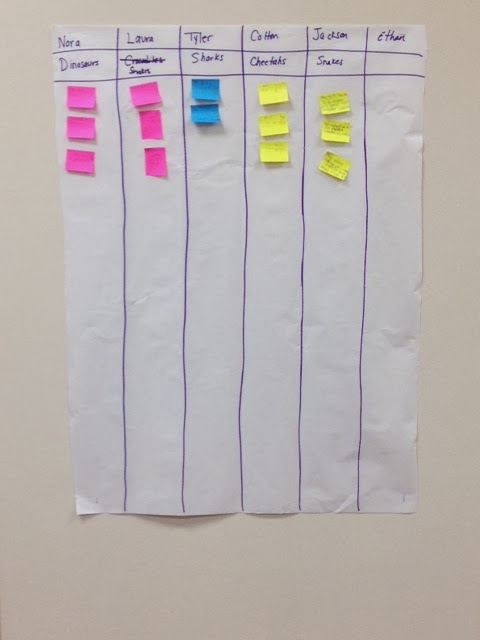 |
| Quick and easy way to organize post-it notes for online reading. Nothing fancy but very effective |
Another cool feature of organizing the notes this way is it allows students who have the same topic to collaborate. They can read a note and then ask the child who wrote it where they found that information. It also drives interest in the topics ahead of time because students will read a note and wonder what other information about that note will be presented.
Overall, I think it's a great way to incorporate something we know works into a method we are sure to be using for many, many years to come. It also creates an anchor chart, builds collaboration and conversation, and it brightens up my room a bit!
What are your thoughts? How have you allowed students to take notes while reading an online text? Have you tried MyOn and what do you think?
Monday, February 17, 2014
5 Reason Why Vertical Alignment is Critical to Student Success
Vertical Alignment--more than a catchy phrase--for successful teachers and students, it's got to be a way of life. More than curricular alignment, instructional alignment is a must-have for any school district that wants students to transition from one grade-level to another without a lot of wasted time and effort. Here are five reasons why vertical alignment must be at the forefront of our educational discussions and practice.

1) Vertical alignment helps teachers work smarter--not harder. Ask a child what they learned today. Nine times out of ten, they're going to answer the same way every time, "I don't know." And its' not because they really don't know, it's because they aren't exactly sure what answer you are looking for or how to articulate one of the many things they learned that day. Therefore, we cannot rely on our students to be able to accurately tell us what they learned from one year to the next. In order for our teachers to move seamlessly from the skill and knowledge demands of one year to the more rigorous demands of the next, we have to be vertically aligned.
2) Vertical alignment builds comprehension and understanding. If I spend an entire year in second grade explaining to my students how to use clues from the literature to make a "best guess" and then the third grade teacher attempts to explain making an inference as "using context to understand the story," she is going to have a really hard time getting all of the information my students already know about how to make an inference to transfer, not because they don't know how but because they haven't connected the language she is using to the language I used last year. We would both be doing our students a solid by getting together and discussing the best way to introduce this concept so that next year's teacher can build upon the skills the kiddos already have, not reinvent the wheel each year.
3) Vertical alignment increases academic vocabulary. Okay, back to the scenario in reason #2. How awesome would it be to hear an entire class of kindergartners explain how they "infer" that the Big Bad Wolf will attempt to blow down the third little pigs house in the same manner that he attempted to blow down the first two little pigs' houses? Well, let's teach our students the academic vocabulary from the very beginning and we will be hearing these statements. There's no reason to dumb it down for them! We want to use the correct vocabulary, give them the meaning (over and over and over again) and ask them to use the vocabulary correctly so that by the time they really must know these words, they have an extremely firm grasp of exactly what these words really mean.
4) Vertical alignment makes us stronger across the curriculum. Vertical alignment actually aids in horizontal alignment as well, particularly when we are talking about upper grade-levels. When lower grade-level teachers who are self-contained are aligning with upper grade-level teachers who are departmentalized, we all become more tightly focused on the same ideas and concepts. There are so many concepts that work across several content areas--systems, change over time, predictions, inertia, the list goes on and on. Aligning these concepts vertically works for all of us. It also allows us to have conversations with teachers who teach other contents so that we can make sure that we are talking about how systems work, for example, using similar vocabulary across the disciplines.
5) Vertical alignment allows our students to take more ownership in their own learning. When students know their teachers are communicating, that each teacher has a vested interest in the students' success, they are more likely to become motivated to succeed. Portfolios are a great way to help track student success from one grade-level to another. They certainly aid in vertical alignment. They also give students an opportunity to show-case what they have learned. Knowing that what occurs in the classroom from one year to the next is a culminating experience helps students to see the importance of being a life-long learner.
These are just a few of the many reasons why vertical alignment is critical to student and teacher success. There are a lot of ways to improve vertical alignment. I am very proud of the way our district has used the Reading Cadre as a vertical alignment piece. We have also talked about using Google Hangout and specific hashtags on twitter for vertical alignment, as well as professional development sessions, such as the roundtable discussions we had today. What other ways can you think of to aid in vertical alignment?
Wednesday, February 5, 2014
Coming Full Circle: From TCEA 2013 to TCEA 2014
It's hard to believe it's TCEA time again. I'm actually writing this post from the Convention Center in Austin between sessions. This blog was born here at TCEA last year and I feel like it's been a successful first year. Who knows what this year will bring--more tech posts, more posts about STAAR prep, more early reading skills--but one thing is for sure, wherever this year takes us, it will be onwards and upwards!
I had my first experience presenting at TCEA this morning and I will be the first to admit I wasa little nervous. Luckily for me, I had an amazing support team from CISD, including my own Tech guru, @getheather, a.k.a. Heather Russell, and my amazing co-presenters Valery Medford and Katie Abrams. I also had my own cheerleader in the front row in Courtney Selby. Though there were a few things I wish had gone slightly differently, overall, I was very happy with the way the presentation went. I said what I wanted to say, timing was good, room was full (with very few early exiters) and I only tripped in front of 100ish people once and didn't even fall down.
In case you were not one of the 100ish people and you missed my presentation, you can find the Prezi for Bloggers Lead the Way! here. My message is and was and always will be this: If you have something to say, say it. Say it in a way that is inspiring and up-lifting. Motivate people to take action. Be a change agent for improvements. If you're an expert, share the wealth. If you're not and you'd like to be, start asking questions. If you read something awesome, pass it along. We can point to all of the things that are wrong in our schools but until we become the responsible party and start doing something about it, we're only going to see the problems and never be the solution.
Oh, and you can do all of that stuff with a blog.
If you are here at TCEA, what has been your favorite part so far? If you're presenting, drop me a line so I can check it out!
Whether you've been reading from the very beginning or you've just started checking-out Reading is Elementary, thanks for the support. Please feel free to leave a comment anytime. Here's to another year of leading the way to great discussion, eye-opening discoveries, and incredible learning for our students.
@AmyVanHornCISD
I had my first experience presenting at TCEA this morning and I will be the first to admit I was
In case you were not one of the 100ish people and you missed my presentation, you can find the Prezi for Bloggers Lead the Way! here. My message is and was and always will be this: If you have something to say, say it. Say it in a way that is inspiring and up-lifting. Motivate people to take action. Be a change agent for improvements. If you're an expert, share the wealth. If you're not and you'd like to be, start asking questions. If you read something awesome, pass it along. We can point to all of the things that are wrong in our schools but until we become the responsible party and start doing something about it, we're only going to see the problems and never be the solution.
Oh, and you can do all of that stuff with a blog.
If you are here at TCEA, what has been your favorite part so far? If you're presenting, drop me a line so I can check it out!
Whether you've been reading from the very beginning or you've just started checking-out Reading is Elementary, thanks for the support. Please feel free to leave a comment anytime. Here's to another year of leading the way to great discussion, eye-opening discoveries, and incredible learning for our students.
@AmyVanHornCISD
Thursday, January 30, 2014
A Simple Way to Get Your Students WRITING
Our school district has been doing a book study on The Best-Kept Teaching Secret by Smokey and Elaine Daniels. In case you haven't read it--the secret is that kids need to write more often. I think we all know that already but I don't know if we truly understand how much writing impacts reading and other academic areas. In the book, the authors give a plethora of ideas for how to get your students writing, regardless of whether you teach elementary or high school. There are tons of pictures and examples, which make the book an easy read and also quite entertaining. Many of their suggestions revolve around letter writing and why this is a great way to get to know students better and build a community within your classroom. I love using letters as part of my curriculum and did so when I was a classroom teacher. Since I've transitioned to my current position, letter writing has been one thing I've let go. I'm exited to start including more of it in my curriculum.
I've also been more cognizant of how often I am asking students to write responses after they read. We know that reading and writing go hand-in-hand, yet I spend a disproportional amount of my time focusing on reading without incorporating many writing skills that will support students in reading. I've been soliciting more writing recently and, while some students still complain because writing is hard for them, I have seen the writing impacting their reading and spelling skills. As a Reading Specialist, my primary focus will still be on reading but I intend to include more written responses into my lessons. Of course, I am talking about thought-provoking and creative writing activities--not writing answers on blanks on a worksheet. We all know that this type of activity does not have the same impact when it comes to improving students' reading and writing skills.
One activity that I have incorporated recently is both simple and fun. I am working with a group of first grade students on extension activities. These are kiddos who are scoring way above grade-level in reading and many of them are also in our Gifted and Talented program. I love working with these types of students because they challenge my thinking as well. This week, we worked on identifying the problem and solution in a story. One of the stories we read was about a dragon with a sore back who needs a more comfortable bed. His human friend finds a solution when heat from a dragon's snort makes all of the corn in the field turn to popcorn. The students loved reading this story but they loved writing about it even more, especially when they got to write on the white board with the dry erase markers. With all of the technology we have today, we sometimes forget the overwhelming joy students have when they are allowed to do "teacher things." This was certainly one of those things that they thought was cool.
While the students loved writing on the board, this was also a very quick way for me to tell who really grasped what the problem was in the story and who needed to do some deeper thinking. Many of the students only wrote a short sentence, but you can see in the picture that one of them wrote a summary. She definitely knew the problem and solution in the story and I let her help me reflect aloud on the story for the other students so that we could all consider how the characters resolved the situation. The entire activity took about 15 minutes (with 6 students) and by the end, everyone had a firm grasp on how to identify the problem and the solution in the story, as well as several other topics that came up during our discussion, which often happens with these creative thinkers. (We had a long chat about mythical creatures and why a dragon is a mythical character but Superman is not.)
How are you incorporating writing in your classroom and how are the students responding?
I've also been more cognizant of how often I am asking students to write responses after they read. We know that reading and writing go hand-in-hand, yet I spend a disproportional amount of my time focusing on reading without incorporating many writing skills that will support students in reading. I've been soliciting more writing recently and, while some students still complain because writing is hard for them, I have seen the writing impacting their reading and spelling skills. As a Reading Specialist, my primary focus will still be on reading but I intend to include more written responses into my lessons. Of course, I am talking about thought-provoking and creative writing activities--not writing answers on blanks on a worksheet. We all know that this type of activity does not have the same impact when it comes to improving students' reading and writing skills.
One activity that I have incorporated recently is both simple and fun. I am working with a group of first grade students on extension activities. These are kiddos who are scoring way above grade-level in reading and many of them are also in our Gifted and Talented program. I love working with these types of students because they challenge my thinking as well. This week, we worked on identifying the problem and solution in a story. One of the stories we read was about a dragon with a sore back who needs a more comfortable bed. His human friend finds a solution when heat from a dragon's snort makes all of the corn in the field turn to popcorn. The students loved reading this story but they loved writing about it even more, especially when they got to write on the white board with the dry erase markers. With all of the technology we have today, we sometimes forget the overwhelming joy students have when they are allowed to do "teacher things." This was certainly one of those things that they thought was cool.
 |
| Each student had the opportunity to write his or her thoughts on the board. |
While the students loved writing on the board, this was also a very quick way for me to tell who really grasped what the problem was in the story and who needed to do some deeper thinking. Many of the students only wrote a short sentence, but you can see in the picture that one of them wrote a summary. She definitely knew the problem and solution in the story and I let her help me reflect aloud on the story for the other students so that we could all consider how the characters resolved the situation. The entire activity took about 15 minutes (with 6 students) and by the end, everyone had a firm grasp on how to identify the problem and the solution in the story, as well as several other topics that came up during our discussion, which often happens with these creative thinkers. (We had a long chat about mythical creatures and why a dragon is a mythical character but Superman is not.)
 |
| A summary of the story, written by a first grader. I love how she was able to synthesize the whole story into a few sentences so succinctly. |
How are you incorporating writing in your classroom and how are the students responding?
Wednesday, January 22, 2014
What Do You Infer?: Simple and Powerful Lessons for Figure 19D
This year I have had the privilege of working with several groups of 3rd grade students. Though many of them are struggling with comprehension, the conversations we have are extremely interesting, particularly when we are practicing making inferences. And we practice making inferences a lot. Because making inferences is hard when you are in 3rd grade--super hard. And STAAR (our state assessment) expects 3rd graders to be able to infer like bosses.
Here are two lessons I use to help students understand the difference between what they know and what they infer. The first lesson builds into the second lesson so I recommend using them both in the same order.
The objective of this first lesson is to teach the difference between gathering information that is obvious and making inferences. I begin the lesson with an introduction to the word inference and all of it's forms (correct or incorrect) such as infer and inferencing. I give them an example of how they often infer information in every day life. I demonstrate this by entering the classroom, shaking a wet umbrella. Immediately, the students say, "It's raining!" I ask them how they know and they site two obvious clues: A) I have an umbrella and B) it's a wet umbrella. I ask them if there are any other ways that I could have possibly gotten the umbrella wet. At first they usually can't think of any but eventually someone will come up with something, such as, "the sprinklers were on." Sometimes they throw in other forms of precipitation, such as, "It might be snowing." This is great because it allows us to talk about the difference between good evidence or clues and jumping to conclusions or using what we call "bad evidence" to make the wrong inference. We talk about how the answers on the STAAR test are often tricky and if they are not very careful, they might use evidence the wrong way or draw conclusions based on "long-shot" sorts of evidence. At the end, we determine that the best explanation for the wet umbrella is that it must be raining outside. We discuss how they were able to infer that without me saying a word. We talk about how they use inferences all day long in real-life.
This leads directly into the next part of this first lesson. The only resource you really need is an interesting photo, which you can easily obtain from the internet. I give the instructions first. "We're going to look at a picture. I want you to look carefully at the picture and then, in a moment, I'm going to ask you to tell me what you see. You can only tell me what you actually see, not what you think is going on." I give the students a few minutes to study the picture and then we discuss what they see. When they accidentally make an inference--and at first this happens very frequently--I stop them and we talk about why their statements were an inference, what evidence they used to draw that conclusion and why it might be incorrect. Usually, their inferences are pretty spot on and I have to really stretch to give them an example of why they might be wrong. This is good for them, however, because it gives them an idea of what misleading evidence looks and sounds like.
After the students have listed all of the things they see, I let them explain what they think is happening. This allows them to practice making inferences. We talk about the supporting evidence that they found. We talk about other possibilities and sometimes there is a bit of debate but most of the time the students draw similar conclusions from the pictures. The kids love this activity and always (and I mean always!) beg to do it again--and then to do another one and another one.
Once my students have practiced this activity a few times, I lead them into the next activity. This one follows the same steps, except for, instead of sharing their thinking out-loud, I have them make a graphic organizer and record their thoughts in writing first and then share. This gives them the opportunity to write, which also allows them to think without being interrupted by someone else shouting out his or her ideas. You can see a picture of the graphic organizer below, but it's pretty simple. I have the students label the top of their paper "Inference" and then make two boxes, one for what they see and one for what they infer. Even though a lot of my students hate to write, they enjoy this activity almost as much as they do the first activity where they are just looking at the pictures. We've done both of these activities several times now and most of the kids are getting to be real pros at it.
Our next step will be to apply our inferences to texts. I will start with good, authentic literature and then transition into grade-level passages that the students can read on their own. I won't introduce written questions and answers until they are very good at both listening to texts and making inferences and then reading texts and making inferences. For higher students, you may not need to scaffold so much but for my friends, this will give them a better opportunity to solidify the skills they are being introduced to, one step at a time. Otherwise, they will never cement the process, they won't have the opportunity to learn how to think or how to pay attention to their own thoughts, and they won't understand the academic vocabulary, which is a huge factor in determining who sinks and who swims when it comes to state assessments (and life in general!)
What lessons do you have for inferencing? Please feel free to post them in the comments!
Here are two lessons I use to help students understand the difference between what they know and what they infer. The first lesson builds into the second lesson so I recommend using them both in the same order.
The objective of this first lesson is to teach the difference between gathering information that is obvious and making inferences. I begin the lesson with an introduction to the word inference and all of it's forms (correct or incorrect) such as infer and inferencing. I give them an example of how they often infer information in every day life. I demonstrate this by entering the classroom, shaking a wet umbrella. Immediately, the students say, "It's raining!" I ask them how they know and they site two obvious clues: A) I have an umbrella and B) it's a wet umbrella. I ask them if there are any other ways that I could have possibly gotten the umbrella wet. At first they usually can't think of any but eventually someone will come up with something, such as, "the sprinklers were on." Sometimes they throw in other forms of precipitation, such as, "It might be snowing." This is great because it allows us to talk about the difference between good evidence or clues and jumping to conclusions or using what we call "bad evidence" to make the wrong inference. We talk about how the answers on the STAAR test are often tricky and if they are not very careful, they might use evidence the wrong way or draw conclusions based on "long-shot" sorts of evidence. At the end, we determine that the best explanation for the wet umbrella is that it must be raining outside. We discuss how they were able to infer that without me saying a word. We talk about how they use inferences all day long in real-life.
This leads directly into the next part of this first lesson. The only resource you really need is an interesting photo, which you can easily obtain from the internet. I give the instructions first. "We're going to look at a picture. I want you to look carefully at the picture and then, in a moment, I'm going to ask you to tell me what you see. You can only tell me what you actually see, not what you think is going on." I give the students a few minutes to study the picture and then we discuss what they see. When they accidentally make an inference--and at first this happens very frequently--I stop them and we talk about why their statements were an inference, what evidence they used to draw that conclusion and why it might be incorrect. Usually, their inferences are pretty spot on and I have to really stretch to give them an example of why they might be wrong. This is good for them, however, because it gives them an idea of what misleading evidence looks and sounds like.
 |
| Start with an interesting picture. What can you see? "A girl. Trees." What do you infer? "She's pretending to be a fairy." Photo courtesy of Glitter and Tulle Boutique |
After the students have listed all of the things they see, I let them explain what they think is happening. This allows them to practice making inferences. We talk about the supporting evidence that they found. We talk about other possibilities and sometimes there is a bit of debate but most of the time the students draw similar conclusions from the pictures. The kids love this activity and always (and I mean always!) beg to do it again--and then to do another one and another one.
Once my students have practiced this activity a few times, I lead them into the next activity. This one follows the same steps, except for, instead of sharing their thinking out-loud, I have them make a graphic organizer and record their thoughts in writing first and then share. This gives them the opportunity to write, which also allows them to think without being interrupted by someone else shouting out his or her ideas. You can see a picture of the graphic organizer below, but it's pretty simple. I have the students label the top of their paper "Inference" and then make two boxes, one for what they see and one for what they infer. Even though a lot of my students hate to write, they enjoy this activity almost as much as they do the first activity where they are just looking at the pictures. We've done both of these activities several times now and most of the kids are getting to be real pros at it.
 |
| On the left, you can see how my student recorded what was happening in the picture. On the right is her inference. |
Our next step will be to apply our inferences to texts. I will start with good, authentic literature and then transition into grade-level passages that the students can read on their own. I won't introduce written questions and answers until they are very good at both listening to texts and making inferences and then reading texts and making inferences. For higher students, you may not need to scaffold so much but for my friends, this will give them a better opportunity to solidify the skills they are being introduced to, one step at a time. Otherwise, they will never cement the process, they won't have the opportunity to learn how to think or how to pay attention to their own thoughts, and they won't understand the academic vocabulary, which is a huge factor in determining who sinks and who swims when it comes to state assessments (and life in general!)
What lessons do you have for inferencing? Please feel free to post them in the comments!
Thursday, January 16, 2014
How to Create and USE a Cut-Off Chart for IStation
I am a huge fan of the computer-based intervention and progress monitoring tool, IStation, or ISIP, or Imagination Station. It goes by many names but whatever you would like to call it, it is a great product and I am very thrilled that both of the campuses I work at have it available for all of our students.
In case you are not familiar with the program, it is a reading intervention that students can use to improve their reading skills. The students take assessments and then play reading games based upon their needs identified in the assessment piece. We use it as an intervention and as a progress monitoring tool. All of our students are required to use it for at least 30 minutes each week but our struggling students use it for 90 minutes each week. I have personally seen tremendous growth from students utilizing this program and I am a big proponent of what it can do, when used along side an excellent classroom reading program. After all, there is no replacement for a great teacher giving individualized instruction. However, IStation is the closest thing to it, in my opinion.
IStation has some great features, including several excellent reports. Our teachers utilize these to track progress, send home information to parents, and to set goals with students. At a campus level, we are able to pull up all the data for a grade-level and look at trends, which students are struggling, specific areas that need growth, etc. The program really does provide a lot of excellent, useful information.
There is, however, one report that I build for our teachers each month. I call it the "IStation Cut-Off" graph and I think it is extremely useful when it comes to grouping students, looking at how close students were to moving up a tier in IStation, and in identifying outliers in a grade-level. I'm going to explain to you how to set this graph up and what I use it for so that you can build it yourself, not just with IStation data but with any assessment data.
The first thing I do is create an Excel spreadsheet or a spreadsheet in google drive. Along the left-side column, I fill in the numbers corresponding to the scores the students needed to obtain in order to reach tier 1 and tier 2. I put the lowest number possible for a tier 1 score as my top number because, at this point, I'm not interested in tracking the students who are scoring in tier 1, the highest tier in the IStation program. I use the "Instructional Tier Goals" chart provided by IStation in the Toolbox section to determine exactly what the cut-off numbers are for tier 1 and tier 2. In order to determine what the final number on my graph will be, I look at the lowest scoring student in tier 3 in that grade-level.
After I have entered the possible scores on the left-side of the graph, I create a green line in the boxes next to the tier 1 cut-off score by filling in those boxes with bright green. This shows me where the students need to be in order to be considered tier 1. I also fill in the boxes next to the cut-off number for tier 2 in yellow to show what score students needed to reach in order to qualify as tier 2. This creates a great visual for determining how close (or how far away) students are from these thresholds.
Next, I print a copy of the Summary report for the grade-level from the IStation reports section. I place each student's name on the graph across from the number of points he or she scored that month. I enter all of the students who are tier 2 or tier 3 for that month. I only put one student's name per box and sometimes there are several students with the same score so they each go in a different box in the same row but different columns.
After all of the students' names are entered, I can easily identify where students are grouped together (which is great for pulling small groups), how close each student is to achieving the next tier, and who my students are that are way off track and hanging out in No-Man's Land as outliers. These are the kiddos I really need information about.
I always share this graph with the entire grade-level, as well as administration. I feel that it provides a great visual so that teachers can see just how much farther students need to grow in order to reach the next tier.
What data tools do you like to use and how to you use them to increase student performance?
In case you are not familiar with the program, it is a reading intervention that students can use to improve their reading skills. The students take assessments and then play reading games based upon their needs identified in the assessment piece. We use it as an intervention and as a progress monitoring tool. All of our students are required to use it for at least 30 minutes each week but our struggling students use it for 90 minutes each week. I have personally seen tremendous growth from students utilizing this program and I am a big proponent of what it can do, when used along side an excellent classroom reading program. After all, there is no replacement for a great teacher giving individualized instruction. However, IStation is the closest thing to it, in my opinion.
 |
| If your district doesn't use IStation, check it out! |
IStation has some great features, including several excellent reports. Our teachers utilize these to track progress, send home information to parents, and to set goals with students. At a campus level, we are able to pull up all the data for a grade-level and look at trends, which students are struggling, specific areas that need growth, etc. The program really does provide a lot of excellent, useful information.
There is, however, one report that I build for our teachers each month. I call it the "IStation Cut-Off" graph and I think it is extremely useful when it comes to grouping students, looking at how close students were to moving up a tier in IStation, and in identifying outliers in a grade-level. I'm going to explain to you how to set this graph up and what I use it for so that you can build it yourself, not just with IStation data but with any assessment data.
The first thing I do is create an Excel spreadsheet or a spreadsheet in google drive. Along the left-side column, I fill in the numbers corresponding to the scores the students needed to obtain in order to reach tier 1 and tier 2. I put the lowest number possible for a tier 1 score as my top number because, at this point, I'm not interested in tracking the students who are scoring in tier 1, the highest tier in the IStation program. I use the "Instructional Tier Goals" chart provided by IStation in the Toolbox section to determine exactly what the cut-off numbers are for tier 1 and tier 2. In order to determine what the final number on my graph will be, I look at the lowest scoring student in tier 3 in that grade-level.
 |
| Building the Cut-Off Graph |
After I have entered the possible scores on the left-side of the graph, I create a green line in the boxes next to the tier 1 cut-off score by filling in those boxes with bright green. This shows me where the students need to be in order to be considered tier 1. I also fill in the boxes next to the cut-off number for tier 2 in yellow to show what score students needed to reach in order to qualify as tier 2. This creates a great visual for determining how close (or how far away) students are from these thresholds.
 |
| The colored lines show the cut-off numbers for tier 1 and 2. |
Next, I print a copy of the Summary report for the grade-level from the IStation reports section. I place each student's name on the graph across from the number of points he or she scored that month. I enter all of the students who are tier 2 or tier 3 for that month. I only put one student's name per box and sometimes there are several students with the same score so they each go in a different box in the same row but different columns.
 |
| Entering the students' names is a great way to see where my groups are and who are the outliers. Names do not reflect real students. |
After all of the students' names are entered, I can easily identify where students are grouped together (which is great for pulling small groups), how close each student is to achieving the next tier, and who my students are that are way off track and hanging out in No-Man's Land as outliers. These are the kiddos I really need information about.
I always share this graph with the entire grade-level, as well as administration. I feel that it provides a great visual so that teachers can see just how much farther students need to grow in order to reach the next tier.
What data tools do you like to use and how to you use them to increase student performance?
Monday, January 6, 2014
What's Your Superpower for the New Year?
School is back in session here at CISD and our kiddos are so excited to be back at school! Okay, maybe not all of them--but most of them! As much as we enjoy being home with our family and loved ones, it is especially nice to hear the excited little voices exclaim our names when we walk through the doors in the morning, as if we are some sort of celebrities.
To many of our kids, we do have celebrity status. We are their heroes--Superheroes--the people who are always there for them. We have a great opportunity to change the lives of these children forever, to give them the tools, knowledge, and skills they need to be successful in this ever-changing world. That is a tremendous amount of responsibility but it is also an amazing honor. So, now is the time to change some lives!
What Superpower will you be using in these next few weeks and months to challenge the thinking of your students?
As we set our plans for the second semester in motion, we will need all kinds of Superpowers to make sure our kiddos are successful. We'll need powers of planning, powers of data review, powers of implementation, and critical-thinking powers! Our kiddos will need these powers, too! We all know that state assessments are looming for most of our kids and it is very easy to let the weight of those assessments bring us down. But we cannot think of state assessments as kryptonite! The approaches that we take in our teaching, the ones that incorporate higher level thinking skills into the curriculum can fundamentally change the way our students approach problem-solving, will not only prepare them for assessments, it will prepare them for life. We need to make sure that we are incorporating as many of these higher-level thinking skills into our lessons plans as possible so that our kiddos grow their super-strengths and are able to defeat all of lives challenges, not just the Evil State Assessments.
As you reflect on the first half of the school year, how do you feel about where your students are? Your answers to these questions may increase your superpowers. How do you feel about your approach to teaching--have you pushed hard enough and asked tough questions? Have you made learning fun and engaging? How have you differentiated for those learners who need scaffolding or more challenging work? Now is the perfect time to reflect on where our students were, where they are now, and where they need to be. The next question is, how do we get them where they need to be?
Knowing the exact level of super-strengths (a.k.a. knowledge and skills) each of your students currently has in reading is critical. If you're not exactly sure what each student is capable of when it comes to reading, there are some great tools that you can use to gather this information. If you have access to a Developmental Reading Assessment (DRA) or something similar, this would give you great information about specific reading skills for each student. Reading A-Z has a similar product with their Benchmark Assessments. You can check those out by visiting the Reading A-Z website here. IStation can also give us some great information as to what our readers can and cannot do. If you're not familiar with this amazing program, you can check it out here. Every student in your classroom needs a clear-cut plan to grow his or her Superpower of Reading to maximum capacity by the end of the year.
In CISD, one way that we have done this with our third grade readers is to give a reading benchmark assessment to determine where our students are currently reading and then classroom teachers and I (the Reading Specialist) created an end goal for each student. For most, this will be the end-of-year reading level expectation for third grade. However, for our students who have special needs or other challenges, this may vary. We looked at how many weeks we had until the student needed to meet that end-of-year goal and set check-points along the way. We will be able to carefully monitor the progress of each student this way, in order to determine whether or not he or she is making adequate gains. If not, we will need to adjust our teaching strategies to meet the individual needs of each student. If a student isn't meeting check-point expectations, we will need to begin discussing what we can do differently, exactly where the student is struggling, and pinpoint our instruction to those exact skills. Without the data from the benchmark and the subsequent check-points, we won't have a clear picture as to whether or not the student is making adequate progress until it's too late. Knowing each of our students and their strengths and weaknesses is critical.
If you haven't done so, I strongly suggest you go back and look at your data and create a plan for each of your students. If you need help doing this, ask a reading specialist, academic coach, team leader, or administrator to help you. If you feel you don't have adequate data on all of your students, discuss what resources are available to you so that you can find out exactly what reading skills each of your students currently has and what they need to learn next, in order to successfully meet grade-level expectations. Great discussions leads to great teaching, which leads to great learning so don't be afraid to approach a colleague to talk about your student data.
It's a new year full of new opportunities. Soon, these students will be on someone else's class roster. When they leave your classroom, will they be prepared? Let's use all of our superpowers to make sure all of our kiddos move on knowing everything they need to in order to be successful next year and for all of the new years to come.
To many of our kids, we do have celebrity status. We are their heroes--Superheroes--the people who are always there for them. We have a great opportunity to change the lives of these children forever, to give them the tools, knowledge, and skills they need to be successful in this ever-changing world. That is a tremendous amount of responsibility but it is also an amazing honor. So, now is the time to change some lives!
What Superpower will you be using in these next few weeks and months to challenge the thinking of your students?
 |
| What's your superpower? Photo courtesy of Glitter and Tulle Boutique |
As we set our plans for the second semester in motion, we will need all kinds of Superpowers to make sure our kiddos are successful. We'll need powers of planning, powers of data review, powers of implementation, and critical-thinking powers! Our kiddos will need these powers, too! We all know that state assessments are looming for most of our kids and it is very easy to let the weight of those assessments bring us down. But we cannot think of state assessments as kryptonite! The approaches that we take in our teaching, the ones that incorporate higher level thinking skills into the curriculum can fundamentally change the way our students approach problem-solving, will not only prepare them for assessments, it will prepare them for life. We need to make sure that we are incorporating as many of these higher-level thinking skills into our lessons plans as possible so that our kiddos grow their super-strengths and are able to defeat all of lives challenges, not just the Evil State Assessments.
As you reflect on the first half of the school year, how do you feel about where your students are? Your answers to these questions may increase your superpowers. How do you feel about your approach to teaching--have you pushed hard enough and asked tough questions? Have you made learning fun and engaging? How have you differentiated for those learners who need scaffolding or more challenging work? Now is the perfect time to reflect on where our students were, where they are now, and where they need to be. The next question is, how do we get them where they need to be?
Knowing the exact level of super-strengths (a.k.a. knowledge and skills) each of your students currently has in reading is critical. If you're not exactly sure what each student is capable of when it comes to reading, there are some great tools that you can use to gather this information. If you have access to a Developmental Reading Assessment (DRA) or something similar, this would give you great information about specific reading skills for each student. Reading A-Z has a similar product with their Benchmark Assessments. You can check those out by visiting the Reading A-Z website here. IStation can also give us some great information as to what our readers can and cannot do. If you're not familiar with this amazing program, you can check it out here. Every student in your classroom needs a clear-cut plan to grow his or her Superpower of Reading to maximum capacity by the end of the year.
 |
| Are your little superheroes ready to fly? Photo courtesy of Glitter and Tulle Boutique |
In CISD, one way that we have done this with our third grade readers is to give a reading benchmark assessment to determine where our students are currently reading and then classroom teachers and I (the Reading Specialist) created an end goal for each student. For most, this will be the end-of-year reading level expectation for third grade. However, for our students who have special needs or other challenges, this may vary. We looked at how many weeks we had until the student needed to meet that end-of-year goal and set check-points along the way. We will be able to carefully monitor the progress of each student this way, in order to determine whether or not he or she is making adequate gains. If not, we will need to adjust our teaching strategies to meet the individual needs of each student. If a student isn't meeting check-point expectations, we will need to begin discussing what we can do differently, exactly where the student is struggling, and pinpoint our instruction to those exact skills. Without the data from the benchmark and the subsequent check-points, we won't have a clear picture as to whether or not the student is making adequate progress until it's too late. Knowing each of our students and their strengths and weaknesses is critical.
If you haven't done so, I strongly suggest you go back and look at your data and create a plan for each of your students. If you need help doing this, ask a reading specialist, academic coach, team leader, or administrator to help you. If you feel you don't have adequate data on all of your students, discuss what resources are available to you so that you can find out exactly what reading skills each of your students currently has and what they need to learn next, in order to successfully meet grade-level expectations. Great discussions leads to great teaching, which leads to great learning so don't be afraid to approach a colleague to talk about your student data.
It's a new year full of new opportunities. Soon, these students will be on someone else's class roster. When they leave your classroom, will they be prepared? Let's use all of our superpowers to make sure all of our kiddos move on knowing everything they need to in order to be successful next year and for all of the new years to come.
Saturday, January 4, 2014
Prayers and Positive Thoughts Needed for One of Our Own
A fund has been established for donations to help the Wood family. Please follow this link to the Love for Heather Wood site. A donation of any amount is greatly appreciated!
 |
| Picture courtesy of M. Knight-Cordova via C. Smith Fitzgerald |
****I will continue to post updates at the bottom of this original post*****
The first day I walked into Press Elementary in McKinney as the Instructional Specialist and Response to Intervention Coordinator, I was a little intimidated. It was a new school, almost every staff member was from a different district, and I really didn't know anyone. The building was available for us to move in literally days before school started. I was on maternity leave with my first child and I was trying to get my room set-up so that my substitute could get to work while I stayed home for the first six weeks of school. I was unpacking boxes while my newborn lay on a blanket on the floor. I hadn't been there very long when I met one of the fourth grade teachers whose room was in the same hallway as mine. I knew that she had also just had a baby and I asked her to keep an eye on Imma while I went off to run an errand. I wasn't gone more than five minutes but when I returned, I found Heather swaying back and forth, humming to my baby, as if she was her own. I knew from that moment, this woman was someone special.
Heather and I worked together in different capacities for four years. She was a teacher the first year. Then, she was Frick to my Frack as I was the Reading Instructional Specialist while she was the Math Instructional Specialist. We co-handled RTI. We were almost always together, especially the second year we worked as dual-IS's, as we also served on a lot of district committees together. If I wasn't sure about something, I asked Heather. If I needed someone to cover something for me or read something before I sent it, or just talk me down off of the proverbial ledge, she was there. She knows everything there is to know about elementary math. She is a wealth of knowledge about RTI, struggling students, and differentiation. She went on to be an outstanding Assistant Principal and Principal. No one ever hesitates to approach Heather, regardless of how intimidating some situations can be, because she is a servant leader who truly cares about the people she works with. She loves every student in the building as if he or she was her very own child. Heather is an amazing educator.
Heather is also an incredible wife and mother. Over the years, I've seen hundreds of pictures of Heather with her two beautiful daughters. I love to hear about their adventures on the lake, visiting family in Oklahoma, or just hanging out on their little farm with all of their animals. They actually named one of their horses Charlie--as in "Charlie Horse"--which is totally cute and silly and just one more reason why Heather and her family are so very lovable.
A few years ago, Heather had a health scare. Everything turned out to be okay but I remember how terrified all of us on the IS team at the time were. It was very unsettling but in the end everything turned out alright. Heather doesn't like to talk about her health and I respect that, but it's something many of us have been concerned about over the years and even when I have gone a while without talking to her, I've always hoped and prayed that she was feeling well.
Over the years, we have gone our separate ways. We ended up in two different districts and while she is now back in McKinney, I'm not. Our main mode of communication is Facebook. Her posts are always cheery and happy, full of silly things her girls have said or places they have visited. Now, however, Heather's Facebook page has turned into a make-shift Prayer Vigil, as she is in an ICU, fighting for her life. The posts today have been a little more positive than yesterday but she is still in grave danger and needs our prayers and positive thoughts.
This page is about education, it's about teaching kids how to read and sharing the wealth of knowledge that we as educators have to impart on each other. Today, however, it is also about one of our own who desperately needs our help. Maybe you're a vigilant Prayer Warrior yourself. Maybe not. But whether you drop to your knees and ask for God's divine intervention or just think, "Gosh, I hope that lady gets better!" it will help. I believe it will help. So I'm asking all of you to please pray or at least think positive thoughts on Heather's behalf. Heather is the type of person who makes the world a better place. She cares about other people, she gives whole-heartedly to those in need, she loves unconditionally. If Heather were to leave us, not only would the world of education sorely miss her, but the world in general would lose a little piece of Heaven.
As we start thinking about returning to school, back to the classroom, back to the students that need us, please keep Heather in your thoughts and prayers. I will keep you updated here as I get more information. Thank you for reading and sharing the post as we spread the word that one of our fellow educators truly needs our help.
Update: (3:03 PM Sat. Jan. 4th) I just heard that Heather's white blood cell count is going up and that kidney function is improving but she still desperately needs our healing prayers. I truly believe that our prayers are working! Please continue to pray for her! Thank you!!
Update: (3:18 PM Sat. Jan. 4th) From a family member: continued slight improvement - bleeding under control except in neck. Platelet count has been stable at 35 after being as low as 9 yesterday. Ventilator at 40% after being at 100% at one point yesterday. Lungs look better. Pulmonologist quote from a few minutes ago: "she's not out of the woods, but she's getting there." Our prayers are working! Please keep them coming!
Update: (8:35 PM Sat. Jan. 4th) Heather's status has been upgraded from critical to "critical but stable." This is good news! Our prayers and positive thoughts are working. Since this time last night when I received word that her little girls had been called in to say good-bye, she has made a vast improvement! Doctors now think she may actually walk out of the hospital on her own in 5-8 weeks! But please don't stop praying now! She still needs to feel our love and support. Thank you so much for all of your kind words and positive thoughts. I know she can feel all of us sending her our love!
Update: (11:03 PM Sat. Jan. 4th) A CaringBridge site has been established for Heather. Here is the link.
Update: (1:19 PM Sun. Jan 5th) Heather continues to make incremental improvements. We still need to pray specifically that the bleeding stops in her neck and that she continues to improve her ability to clot. She has been more responsive today and her color is better. Please continue to pray for Heather's body to heal, for her medical team to continue down the right path, and for comfort for her family and friends. Thank you all very much!
Update: (9:17 AM Mon. Jan 6th) Heather had a great night last night. She was able to respond to all commands and responded when the hospital staff talked about her daughters. We need to continue to pray that her platelet count increases and that her body continues to heal. Thank you all again for all of your prayers and positive thoughts!
Update (12:57 PM Jan 7th) Heather had another good night. She was able to respond to simple commands and teared up at the mention of her girls. Please continue to pray for body to fight off the infection. Even these incremental improvements are blessings.
Update (7:45 AM Jan. 8th) Heather had another good night last night. It was expected that she would need temporary dialysis but when her labs came back, they showed that her kidneys were functioning well enough that she does not need any dialysis at this time. She has also been able to stay fever free for the last few days. Specific prayers needed now are that she continues to fight the infection and that her extremities begin to heal. Both Heather and her husband, Eddie, are educators. Once they run out of sick days, they will have no income coming in at all. Please consider donating to the Love for Heather Wood fund so that this family does not have a financial crises to deal with once this medical crises is over.
Update (7:45 AM Jan. 9th) Heather has stabilized and continues to make slow progress. Her sister, who is also a nurse, reports that she is doing a little better each day and she is fine with the slow progress as long as she does not get any worse. Heather's donation site had hundreds of visitors yesterday and the goal had to be increased because of the amazing generosity of her friends, family, and even strangers who had heard of her story. If you would like to donate, please see the link in the post above. Please continue to pray for Heather and her family.
Update (7:45 Jan. 13) It has been a good weekend for Heather! She continues to make slow and steady progress. She was allowed to come out of sedation and has been very responsive. She has spent most of her time sleeping while her body continues to heal. Thank you all so very much for your continued prayers!
Update (7:45 Jan. 16) Heather is doing amazingly well! She started opening her eyes a few days, followed shortly by talking! She was actually able to make a phone call to one of her friends yesterday. This is truly a miracle! We are all so thankful for all of the prayers and well-wishes. Please continue to pray that Heather will find her strength and keep fighting the infection so that she can be home with her family soon.
Update: (7:45 Jan. 22) Heather's recovery has been nothing short of a miracle. While she still needs to regain her strength and continue to fight the infection, she is able to talk, visit with her family, and stay awake for long stretches of time. Thanks again for all of your prayers!
Subscribe to:
Posts (Atom)